Back to posts
Google Ads for HVAC: What Actually Books Jobs

Dash Sze
10 mins read
Aug 13, 2026
Overview
Google Ads can be the fastest way for an HVAC company to fill their schedule, or also the fastest way to set money on fire. The gap between the two comes down to a few decisions most contractors get wrong. The biggest one is treating Google Ads as a single thing, when it’s really two very different products: pay-per-lead Local Service Ads and pay-per-click search ads. The corner that reliably pays for heating and cooling companies is Local Service Ads, the pay-per-lead ads with the verification badge at the very top of the page, and it’s the corner most HVAC shops underuse while overspending everywhere else.
This is one spoke of our HVAC marketing hub, the bigger guide to getting found across Illinois. Here we focus on one piece: making paid ads book jobs instead of burning your budget. That comes down to two things — running Local Service Ads well, and stopping the leaks quietly draining your regular search campaigns.
Are Google Ads worth it for HVAC companies?
Yes, especially Local Service Ads, which charge you per lead instead of per click and posted the strongest return of any home-services trade in 2026 at roughly $51 per lead. But ads only pay when you answer the phone fast and send clicks to service-specific pages. Run loose, and 20% to 35% of the budget is wasted on the wrong searches.
Local Service Ads Is the Channel You’re Underusing
If you do only one thing with paid ads, run Local Service Ads. For HVAC companies in 2026 it delivered the strongest return of any home-services trade tracked, at about $51 for each lead, with 44% of those leads turning into booked jobs, for roughly $9.55 in revenue back on every dollar spent (SearchLight Digital, 2026). Out of every ten leads it sends you, between four and five become paying work. No other paid channel in this trade comes close.
Local Service Ads sit at the very top of a Google search, above the regular ads and above the map, with a small verification badge next to your name. The thing that makes them different is how you pay. With regular search ads you pay every time someone clicks, whether they call or not. With Local Service Ads you pay per lead, which means you’re charged only when a real person actually contacts you. You’re buying the conversations, not just clicks.
How pay-per-lead works, and what changed in 2026
That badge used to be called the Google Guaranteed badge, and it came with a money-back guarantee Google offered the homeowner. Both of those changed recently. In late 2025 Google folded the old “Google Guaranteed” and “Google Screened” badges into a single “Google Verified” checkmark, and it discontinued the money-back guarantee (Google, Local Services Ads Help, support.google.com). The badge is also shown more selectively now, so you can’t count on it appearing every time. Here’s what to take from that: the badge is a smaller trust boost than it was a year ago, so the trust signals you do control — mainly your review count and rating — now do more of the work of winning the click.
To run Local Service Ads at all, you pass a license and insurance check and connect the account to your business. Then Google decides how often to show you — and that frequency turns largely on how fast you answer, which is where most contractors leave money on the table.
Why fast pickup decides your ranking and your cost
Here’s what most people never optimize for: responsiveness. Google has said how quickly you answer is one of the things that influences where your ad shows. Google doesn’t publish the exact signals, but the direction is clear from its own guidance and from practitioners who run these accounts. How quickly you pick up appears to feed where you rank. Let calls go to voicemail, and do this enough times, your placement will slip — meaning you’ll start paying more for fewer results (Google, Local Services Ads Help; Boomcycle, 2026).
So the biggest advantage goes to the shops that answer every call during the hours they’re open, instead of letting the phone ring out. Most HVAC contractors do one of two things wrong with Local Service Ads. They ignore the channel entirely and pour everything into regular search, or they switch it on and then let half the leads ring out during a busy week. Both waste the budget.
If a lead does come in junk, say a wrong-number or a spam call, Google’s system now reviews leads automatically and credits the clearly invalid ones. There’s a limit to that automation, though. Google no longer accepts manual disputes for “job type not serviced” or “outside my area,” so if you get charged for a service you don’t offer or a town you don’t cover, there’s no appeal — you have to set your job types and service area precisely up front (Google, Local Services Ads Help, support.google.com; Search Engine Land, 2026).
Ask Yourself These Questions
- When a Local Service Ads call comes in during a heat wave and your techs are on roofs, who picks up — a person, or voicemail?
- How many Google reviews do you have, now that the badge does less of the convincing?
- Are you even running Local Service Ads, or is your whole paid budget sitting in regular search ads?
Why Most HVAC Google Ads Bleed Money
Most HVAC search campaigns waste 20% to 35% of their budget in the first month — often more, since a brand-new account is still gathering data and bidding too broad — and it’s almost always the same handful of leaks (Gatorworks, 2026). Fixing them doesn’t take a bigger budget. It takes plugging the holes the budget is pouring out of.
The first leak is not using negative keywords. Negative keywords are the searches you tell Google to never show your ad for. Without a list of them, your “AC repair” ad shows for “AC repair DIY,” “AC repair training,” and “AC repair jobs,” and you pay for every one of those clicks from people who will never hire you. A do-it-yourselfer and a job-seeker both cost you the same as a homeowner with a dead furnace. That single missing list is where most of the 20% to 35% goes.
The second leak is having a single catch-all campaign. When you put repair, installation, and maintenance keywords into one campaign with one budget, they fight each other, and the high-value emergency-repair searches that should win during a cold snap get starved by cheaper clicks (Gatorworks, 2026). Separate them so you can fund the ones that book the big jobs.
The third leak is the landing page. Sending paid clicks to your homepage instead of a page about the exact service they searched for drops your conversion rate by 30% to 50% (DUO Digital, 2026). Someone who searched “furnace replacement” should land on a furnace replacement page, not a generic homepage that makes them hunt.
The fourth leak is geography, and it cuts both ways. If your targeting radius stretches past the towns you actually serve, you pay for clicks from homeowners you’d never drive to (Hook Agency, 2026). But the reverse is just as costly when you’re trying to grow. Say you’ve built your book in the southwest suburbs and you want to start taking work on the North Side of Chicago. If your campaigns are still geo-fenced to Orland Park and Tinley Park, Google will never show your ad to the Lincoln Park homeowners searching “furnace repair near me,” no matter how good your account is. Branching into a new area means opening the targeting to it deliberately, then watching the cost per booked job in that zone on its own before you scale it.
There’s a fifth mistake that isn’t a leak so much as chasing the wrong number. Plenty of contractors look at a shared-lead site like Angi, see a lower price per lead than Google, and switch budget over. The trap is that Angi sells the same lead to several contractors at once, so those leads close at only 8% to 15%, while an exclusive Google lead is yours alone and closes far higher (Hnatewicz Media, 2026). A cheaper lead that rarely closes is more expensive than a pricier lead that does. Cost per booked job is the number that matters, not cost per lead.
Bidding to the Illinois calendar
Speed is the multiplier that sits on top of all of this. In home services, 78% of customers hire the first company that responds (Lead Connect research, via DUO Digital, 2026), and separate lead-response research has long found that calling a web lead back within five minutes dramatically raises your odds of reaching them versus waiting an hour (MIT/InsideSales Lead Response Management study). You can win the click and still lose the job to whoever called back first.
Then there’s timing the spend to Illinois weather. Demand here swings hard, so your budget should too. Start raising your cooling budget around 20% in March and push it to 140% to 150% of your baseline by May, before every competitor floods in (BestPPC, 2026). Do the same ahead of the January heating peak. And watch the forecast. Raising your budget a day or two before a hard freeze or a heat wave puts you in front of the exact homeowner whose system is about to fail. Say you run a shop in the southwest suburbs and the forecast calls for a −5°F weekend. That’s the moment to push the budget, not the Monday after, when everyone’s already been served.
Ask Yourself These Questions
- Do you have a negative keyword list, or is Google free to spend your money on “HVAC training” clicks?
- Where do your ad clicks land — a page about what they searched for, or your homepage?
- When the forecast turns brutal, does your budget move with it, or stay flat?
The Benchmarks, in One Place
Here’s what good looks like in 2026, so you can judge your own account against real numbers instead of guessing.
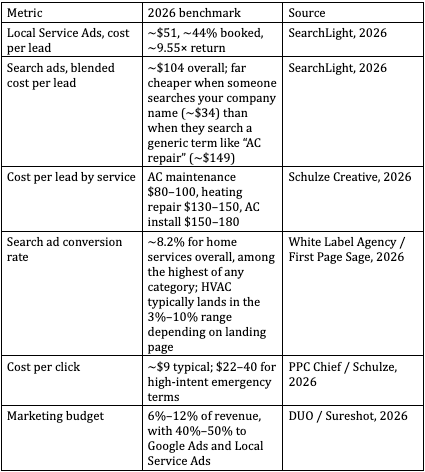
One more number to anchor everything. Aim for at least three dollars of customer value for every dollar you spend to acquire that customer, and five to one if your operation is dialed in (DUO Digital, 2026). An HVAC customer is worth far more than a single job. Once you count the repeat service, the maintenance visits, and the eventual system replacement, a lead that costs $150 but books a $9,000 install and years of follow-on work is cheap. That’s the math that should drive your spend, not the headline price of a click.
Paid ads are also only half the equation. The same reviews and local presence that win you organic calls feed your ad performance too, since your review count props up both your Local Service Ads ranking and your click-through rate. We cover that in the local SEO guide for HVAC.
Get Qualified Calls Coming In
If your Google Ads are spending without booking, the problem usually isn’t the budget — it’s how the account is built. Adotme is a Chicago-based agency that runs paid acquisition for Illinois home-services businesses, and we’ll give you a free ad audit that tells you straight whether your spend is working or leaking.
Take a look at our Digital Advertising services if you want qualified calls coming in before the next seasonal peak, or tell us what your cost per booked job looks like now and we’ll point to the biggest fix. Prefer to talk it through? Call (708) 250-4790.
FAQ
Are Google Ads worth it for HVAC companies?
Yes, when they’re run well. Local Service Ads in particular posted the strongest return of any home-services trade in 2026, at roughly $51 per lead with about 44% of leads booking, because you pay per lead instead of per click and the calls tend to be high-intent. Regular search ads work too, but only with negative keywords, service-specific landing pages, and tight geo-targeting. Run without those, and a fifth to a third of the budget is wasted on clicks that never become customers.
What’s a good cost per lead for HVAC Google Ads?
Around $51 per lead through Local Service Ads is excellent, and the blended cost per lead through regular Google Search ads runs near $104 in 2026. Costs vary by service, from about $80 to $100 for AC maintenance up to $150 to $180 for installations. The more useful number is your cost per booked job, not per lead, since an exclusive lead that closes is worth far more than a cheap shared lead that rarely does.
Should I run Local Service Ads or regular Google Search ads first?
Start with Local Service Ads. They cost less per lead, the leads convert better, and you only pay when someone actually contacts you. Once that channel is producing and you’re answering every call quickly, add regular search ads to capture the searches Local Service Ads doesn’t cover, like specific installation or replacement terms. Most HVAC companies get the order backwards and overspend on search before they’ve maxed out the cheaper channel.
Why are my HVAC Google Ads not converting?
The most common reasons are sending clicks to your homepage instead of a page about the searched service, which drops conversions 30% to 50%, and missing negative keywords, which spends budget on do-it-yourselfers and job-seekers. Slow phone response is the other big one, since 78% of customers hire whoever calls back first. Fix the landing page, build a negative keyword list, and make sure a person answers fast, and conversions usually climb without spending another dollar.
Are Angi or Thumbtack leads better than Google Ads?
Usually not, once you look past the sticker price. Shared-lead sites like Angi and Thumbtack sell the same lead to several contractors at once, so those leads close at only 8% to 15%, while an exclusive Google or Local Service Ads lead is yours alone and closes far more often. A cheaper lead that rarely books costs you more per actual job than a pricier exclusive one. Compare channels on cost per booked job, not cost per lead.
How much should an HVAC company budget for Google Ads?
A healthy total marketing budget in 2026 is 6% to 12% of revenue, with roughly 40% to 50% of that going to Google Ads and Local Service Ads combined. Just as important is weighting the spend to the calendar, scaling up before the January heating peak and the July cooling peak in Illinois and raising budgets a day or two ahead of a hard freeze or heat wave. Aim for at least three dollars of customer value for every dollar spent acquiring a customer.
External references: SearchLight Digital — Local Service Ads Cost Per Lead by Trade · Google — About the Google Verified badge (Local Services Help) · Search Engine Land — Google Automates Lead Credits for Local Services Ads · First Page Sage — Average Conversion Rate for Google Ads 2026 · WordStream / LocalIQ — Google Ads Benchmarks
Frequently Asked Questions (FAQs)
Are Google Ads worth it for HVAC companies?
Yes, when they’re run well. Local Service Ads in particular posted the strongest return of any home-services trade in 2026, at roughly $51 per lead with about 44% of leads booking, because you pay per lead instead of per click and the calls tend to be high-intent. Regular search ads work too, but only with negative keywords, service-specific landing pages, and tight geo-targeting. Run without those, and a fifth to a third of the budget is wasted on clicks that never become customers.
What’s a good cost per lead for HVAC Google Ads?
Around $51 per lead through Local Service Ads is excellent, and the blended cost per lead through regular Google Search ads runs near $104 in 2026. Costs vary by service, from about $80 to $100 for AC maintenance up to $150 to $180 for installations. The more useful number is your cost per booked job, not per lead, since an exclusive lead that closes is worth far more than a cheap shared lead that rarely does.
Should I run Local Service Ads or regular Google Search ads first?
Start with Local Service Ads. They cost less per lead, the leads convert better, and you only pay when someone actually contacts you. Once that channel is producing and you’re answering every call quickly, add regular search ads to capture the searches Local Service Ads doesn’t cover, like specific installation or replacement terms. Most HVAC companies get the order backwards and overspend on search before they’ve maxed out the cheaper channel.
Why are my HVAC Google Ads not converting?
The most common reasons are sending clicks to your homepage instead of a page about the searched service, which drops conversions 30% to 50%, and missing negative keywords, which spends budget on do-it-yourselfers and job-seekers. Slow phone response is the other big one, since 78% of customers hire whoever calls back first. Fix the landing page, build a negative keyword list, and make sure a person answers fast, and conversions usually climb without spending another dollar.
Are Angi or Thumbtack leads better than Google Ads?
Usually not, once you look past the sticker price. Shared-lead sites like Angi and Thumbtack sell the same lead to several contractors at once, so those leads close at only 8% to 15%, while an exclusive Google or Local Service Ads lead is yours alone and closes far more often. A cheaper lead that rarely books costs you more per actual job than a pricier exclusive one. Compare channels on cost per booked job, not cost per lead.
How much should an HVAC company budget for Google Ads?
A healthy total marketing budget in 2026 is 6% to 12% of revenue, with roughly 40% to 50% of that going to Google Ads and Local Service Ads combined. Just as important is weighting the spend to the calendar, scaling up before the January heating peak and the July cooling peak in Illinois and raising budgets a day or two ahead of a hard freeze or heat wave. Aim for at least three dollars of customer value for every dollar spent acquiring a customer.
Relevant Topics:

Dash Sze
Adotme Copywriting Team
"I write strategic content that drives traffic, converts audiences and scales brands."