For an HVAC company, local SEO in 2026 is mostly three things done well. A Google Business Profile that’s complete and constantly updated, a steady stream of recent reviews, and service-area pages that are genuinely about the towns you serve instead of one template with the city name swapped out. Get those three right and you show up in the map results across your service area, which is the entry ticket to everything else, including being recommended by AI tools and being reachable by Google’s new AI calling feature, called “Ask for Me,” where Google’s assistant phones local contractors on a searcher’s behalf to check pricing and availability (announced at Google I/O in May 2026 and expanding to home services). It only calls businesses that already rank in local results, which is the whole reason this article exists.
This is one spoke of our HVAC marketing hub, the broader guide to getting found and getting chosen across Illinois. The hub makes the case that ranking is now the price of admission, not the win. This spoke is the how. We’ll spend the whole article on the three levers that move local rankings most, because a furnace shop that nails these outranks competitors with bigger budgets and worse fundamentals.
How do HVAC companies rank in local search in 2026?
With a complete, actively updated Google Business Profile in the right category, a steady flow of recent reviews, and genuine service-area pages for the towns you serve rather than cloned city pages. Your profile alone drives about a third of local ranking and is the entry ticket to being named in AI results.
Your Google Business Profile Is the Engine
Your Google Business Profile is the single biggest factor in whether you show up in local search, and in 2026 it only works if you keep it moving. Industry analysis of local ranking factors puts the profile at roughly a third of what decides the local map results, the single largest factor, ahead of reviews, links, or your website on their own (Whitespark 2026 Local Search Ranking Factors survey). Your Google Business Profile is the free listing that shows your name, hours, photos, and reviews in Google Maps and in the little boxed set of local businesses at the top of a search, which the industry calls the local pack or map pack. If yours is thin or neglected, you’re invisible where most HVAC searches actually get decided.
Start with the setting that matters most. Your primary category is the strongest single lever inside the profile, so it has to be exactly right. “HVAC contractor” is not the same as “air conditioning repair service” to Google, and picking the precise category for your core work moves you more than almost anything else you can do (BrightLocal, 2026). After that comes proximity, meaning how close you are to the person searching, which you can’t control, and the keywords in your business name, which you shouldn’t stuff. More on why stuffing backfires in a moment.
Why a “set it and forget it” profile now loses ground
Here’s what changed in 2026, and it catches a lot of contractors off guard. Google now rewards profiles that are actively maintained and quietly demotes the ones that sit still. Profiles updated continuously, with weekly posts, fresh photos every couple of weeks, prompt review replies, and an active question-and-answer section, tend to hold position over dormant ones with the same star rating, because Google increasingly favors profiles that “look alive” (Search Engine Journal, 2026). Practitioners have also noticed profiles that go 30 or more days without an update tend to lose impressions, a “freshness” effect several local-SEO agencies report tracking, though Google has not published any such 30-day rule (Explore Digital, 2026). Treat it as an observed pattern, not a confirmed Google mechanic.
So the old advice to “set up your profile and forget it” is now actively costing you ranking. A profile is a feed you maintain, not a form you fill out once.
There’s a catch worth stating plainly, because it’s exactly where good intentions backfire. “Fresh” means adding to the profile, not rewriting its foundation. Posts, photos, and review replies are safe to update as often as you like. Your business name, address, phone number, and primary category are not. Changing those repeatedly, or flipping your category back and forth to chase a keyword, is one of the fastest ways to trip Google’s automated compliance checks and get the whole profile suspended. Keep the feed active and the core details stable, and you get the freshness benefit without the risk.
Being open at the moment someone searches has also become a real ranking factor, sitting around fifth on the list in 2026 (Search Engine Journal, 2026). For a 24/7 emergency HVAC company that’s an advantage, as long as your hours are set to reflect it. The payoff for all this is concrete. Landing in the map pack tends to drive far more phone calls than a low organic position, with one HVAC marketing agency estimating two to five times the volume (Foxxr, 2026). Treat that range as a vendor estimate rather than a measured benchmark, but the direction is consistent across the industry. The map pack is where the calls are.
Ask Yourself These Questions
- Is your primary category the exact one for your core work, or a vague catch-all?
- When did you last post to your profile or reply to a review — this week, or sometime last quarter?
- If a homeowner searches at 11pm during a freeze, do your hours tell Google you’re open?
Reviews Are the Second Engine
Reviews are the second-biggest lever you actually control, and the part most contractors get backwards. What moves you is how recently and steadily new reviews arrive, more than the size of your all-time total. Analysis of thousands of local listings has found that recent review activity, meaning the reviews you earned in roughly the last month, tracks with map-pack position more closely than a big lifetime count sitting still (Sterling Sky, 2025). A furnace shop with 90 reviews and a steady handful every week routinely outranks one with 400 reviews and nothing since last spring.
Treat reviews as an ongoing habit. A slow, constant trickle of a few genuine reviews a week beats a single big push that then goes silent, because the flow itself is the signal Google reads. Set up a simple system that asks every customer right after the job, while the work is fresh in their mind.
The text inside the review matters as much as the star rating. Google reads the words to understand what you actually do, so a review that names the job, the equipment, and the town, something like “replaced our AC in Tinley Park in July,” tells Google far more than five silent stars. It also feeds the AI recommendation we get to below. So when you ask, ask in a way that invites detail. “We’d appreciate your honest take on how the job went” earns a more useful review than “please leave us five stars.”
Here’s the line you cannot cross. Do not screen customers first and route only the happy ones to Google. That practice, called review gating, is an explicit Google policy violation, and funneling reviews through a tool that pre-filters sentiment can get them stripped or your profile flagged. Ask every customer the same neutral way, not just the ones you expect to rave, and space the requests out naturally rather than blasting fifty in one afternoon, which Google’s spam filters read as manipulation. Legitimate reviews sometimes vanish anyway as Google’s automated filters tighten, so a steady, honest flow is also your insurance against a bad filtering week.
Finally, reply to them, the good and the bad. Google has said helpful replies help your business stand out, a prompt and specific response shows the profile is active, and a calm answer to a hard review does more for a watching homeowner than a wall of flawless five-stars ever could.
Ask Yourself These Questions
- How many genuine reviews did you earn in the last 30 days, not just in total?
- Do your reviews name the actual jobs and towns, or are they mostly silent stars?
- Are you asking every customer the same neutral way, or quietly steering only the happy ones to Google?
Service-Area Pages Without the Doorway Trap
The way you cover your service towns on your website can help you or get you penalized, and the line between the two is sharper than most contractors realize. The wrong way is the one almost everyone defaults to, which is taking a single page, copying it for every town, and swapping in the city name. The right way is fewer pages, each genuinely about its area. Get this wrong and Google treats your site as spam.
Here’s the rule Google enforces. A service-area page is a page about the work you do in a specific place, like “furnace repair in Joliet.” When you clone one template across a dozen towns and the pages share something like 95% of the same text, Google classifies that as a doorway page, which is a page built only to catch a keyword while offering the visitor nothing the other pages don’t (rankingCoach, 2026). It’s the exact pattern Google’s doorway policy was written to catch, and AI writing tools have made it easier than ever to mass-produce by accident (RicketyRoo, 2026).
So how do you cover real ground without tripping the wire?
How to cover Chicago and the suburbs the right way
Build one page per meaningful area, not one per keyword, and make each page substantially different from the others, not a city-name swap. Fill each with real local detail like your response times to that town, the neighborhoods and housing stock you see there, the common calls you get, and any access or permit quirks (Bipper Media, 2026). Keep the count sane, too. Focusing on 15 to 20 key service areas you actually serve well beats spinning up a hundred thin pages for towns you’ll never drive to.
Structure them so a visitor and Google can both navigate the set, with a clear path from your home page to a locations hub to each town’s page, rather than a flat pile of near-identical URLs (SOCi, 2026). That browsable structure is the legitimate version of what doorway farms fake.
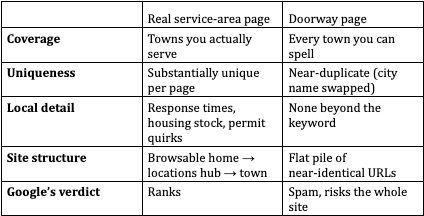
Say you serve Orland Park, Tinley Park, and Homer Glen. A real Orland Park page talks about the older furnaces in the established neighborhoods there, your typical drive time, and the permit process with that village. A fake one just says “HVAC repair in Orland Park” five times around boilerplate every other town page also uses. The first earns the ranking. The second risks the whole site. You can see how we structure legitimate coverage across our Illinois service areas, and the underlying principles tie into what we’ve written about on-page work that moves rankings.
One more thing that belongs on these pages, and it’s the place where stuffing actually hurts you. Don’t jam keywords into your business name on your profile or mismatch your service areas to look bigger than you are. Google is suspending profiles at record rates in 2026, and those two moves are common triggers (OAK Interactive, 2026).
Ask Yourself These Questions
- If you opened two of your town pages side by side, how much of the text is actually different?
- Do you have pages for towns you genuinely serve, or for towns you wish you served?
- Could a visitor click from your home page to a specific town page in one obvious step?
From Local Ranking to AI Recommendation
Strong local SEO is now the prerequisite for showing up in AI answers, not a separate project. The same Google Business Profile, reviews, and citations that win you map rankings are exactly what AI tools read when they decide which contractor to name, and AI systems tend to draw from the businesses already ranking in local results for the searcher’s area (JobNimbus, 2026). A citation, in this context, is any mention of your business name, address, and phone number on another site, like Yelp, Angi, or a local directory, and it tells both Google and AI tools that you’re a real, consistent business. Citations appear to weigh more heavily for AI answers than they do for the regular map pack, and seem to count among the top factors AI uses (Advice Local, 2026).
Citations are only half the story, though, and probably the smaller half. They prove you exist and that your details line up across the web. What actually tips an AI toward naming you is what other people say about you in plain language. Assistants like ChatGPT, Perplexity, and Gemini lean hard on unstructured reviews and mentions — the detail inside your Google review text, threads on Reddit, comments on Nextdoor — and they read that text for sentiment and specifics, not for a star average. A review that says “they fixed my Goodman furnace on a freezing Sunday in Tinley Park” is worth far more to you than five silent stars, because it hands the AI the exact brand, service, urgency, and place it needs to recommend you for that job. Coaching your happy customers to describe what you actually did, in their own words, feeds your map ranking and your AI odds at the same time.
Two technical pieces help here. First, mark up your website with what’s called schema, which is hidden code that labels what your business is and where it operates in a format machines read cleanly. Use the LocalBusiness type, and the more specific HVAC subtype where your developer can confirm it, so AI systems classify you correctly. Second, keep your FAQ schema even though Google stopped showing FAQ rich results in May 2026, because Google has said it still reads that markup to understand your page, and AI engines use it too. We dig into the AI side of this in our companion piece on why a business can rank number one and still not get cited by AI.
TL;DR
- Your Google Business Profile is the biggest lever, about a third of local ranking. Get the primary category exactly right and treat the profile as a feed you keep active, with fresh posts and photos but your name, address, and category left stable.
- Recent reviews are the second engine. A steady weekly trickle of detailed reviews that name the job and town beats a big lifetime total sitting still, and never screen customers to send only the happy ones to Google.
- Don’t clone city pages. Near-identical service-area pages are doorway spam; build 15–20 genuinely local pages, each substantially unique, with real detail and a browsable structure.
- Avoid the suspension triggers. Keyword-stuffed business names, inflated service areas, and churning your core details get profiles suspended at record rates in 2026.
- Local SEO is the gateway to AI. The same profile, reviews, and citations that rank you in maps are what AI reads first, and the specific text in your reviews, not a star average, tips it toward naming you.
Get Found Where Homeowners Look
If your HVAC company isn’t showing up in the map results across the towns you serve, the fix is almost always the profile, the reviews, and the pages, not a bigger ad budget. Adotme is a Chicago-based agency that builds local search for Illinois home-services businesses, the kind that earns calls without paying for every one.
See our Organic SEO services if you want to rank across your service area, or tell us which towns you’re invisible in and we’ll show you why. You can also reach us at (708) 250-4790.
FAQ
How do I rank my HVAC business on Google Maps?
Start with your Google Business Profile, which drives about a third of local map ranking. Set the exact primary category for your core work, fill out every field, add geo-tagged photos, and keep it active with weekly posts and quick review replies, since Google now favors profiles that are continuously updated. Then build genuine service-area pages for the towns you cover and earn a steady stream of recent reviews. Together those move you into the local pack, where the call volume is, often several times that of a low organic position.
How many service-area pages should an HVAC website have?
Focus on 15 to 20 pages for the towns you genuinely serve, not a hundred thin ones. Each page should be substantially unique, with real local detail like your response times, the housing stock you see in that area, and common calls you get there. The goal is one meaningful page per area, not one page per keyword. Padding your site with near-identical city pages is counterproductive and risks a penalty.
Do I need a separate page for every town I serve?
Only for towns you actually serve and can write about specifically. Cloning one template across every nearby town and swapping the city name creates what Google calls doorway pages, which it treats as spam and can penalize. A real page for a town you serve, with genuine local detail, helps you rank. A copy-paste page for a town you barely cover hurts the whole site. Cover the areas you know well and skip the ones you don’t.
What schema should an HVAC website use?
Use LocalBusiness schema, which is hidden code that tells search engines and AI tools who you are, where you operate, and what you do, and apply the more specific HVAC subtype where your developer can confirm it. Keep FAQ schema too, even though Google stopped showing FAQ rich results in May 2026, because Google still reads it to understand your page and AI engines use it to pull answers. Schema won’t rank you on its own, but it helps machines classify and cite you correctly.
Why did my Google Business Profile get suspended?
The most common triggers in 2026 are stuffing keywords into your business name, such as “Joe’s HVAC Repair Furnace AC Chicago,” and setting service areas far wider than you actually serve. Repeatedly editing your core details, meaning your name, address, or primary category, can also trip Google’s automated compliance flags, so change those only when they genuinely change. Google is suspending profiles at record rates and these are frequent causes. Use your real business name, set honest service areas, and keep your name, address, and phone number consistent everywhere online. If you’re suspended, fix the violation before requesting reinstatement.
Does local SEO help my HVAC company show up in AI search?
Yes, directly. AI tools like Google’s AI answers and ChatGPT lean heavily on businesses that already appear in local search results for the searcher’s area, so ranking locally tends to be the prerequisite for being named by AI at all. The same signals that drive your map ranking, mainly your Google Business Profile, recent reviews, and consistent citations across the web, are what AI systems read when choosing which contractor to recommend. Strong local SEO and AI visibility are now the same project.
External references: Whitespark — 2026 Local Search Ranking Factors Survey · Sterling Sky — What Actually Gets You Ranking for “Near Me” (2025) · Advice Local — 2026 Local Search Ranking Factors · Google Search Central — Local Business structured data · Search Engine Journal — Dynamic Profiles and Local Ranking · Search Engine Land — Service Area Pages Guide