Back to posts
Small Ad Budget 2026: What $500 a Month Actually Buys

Dash Sze
10 mins read
Sep 14, 2026
Summary
Every platform will happily take your $500 ad budget, which is why it’s more important than ever to find out where your budget will work best. Snapchat’s minimum is $5 a day. LinkedIn’s is $10. TikTok wants $50 at the campaign level. Then, Amazon Sponsored Products can run as low as a dollar a day.
None of those numbers tell you what you need to know, because the minimum is just the least the platform will accept. It is not the amount at which the platform’s own system can tell whether your ads are actually working.
The amount where the algorithm finally has enough data to judge your ads, is much larger, and almost nobody publishes it.
Google’s documentation for Smart Bidding, its automated bidding system, says to measure performance over periods with at least 30 conversions. A conversion is any result you count as a win, like a form fill, a phone call, sale, or click.
WordStream’s 2026 benchmark study, built on 13,474 US search campaigns between April 2025 and March 2026, puts the average cost per lead at $66.69. Divide $500 by $66.69 and you’re getting roughly 7.5 leads a month.
The rest comes down to what $500 actually buys across the Chicago verticals that matter, what automated bidding does on a budget this small, and the three places where $500 genuinely works.
This is a companion to our guide on which advertising platform fits your business.
What $500 actually buys, by vertical
Start with the blended average, the figure you get when every industry is averaged together, then narrow it to your business. The blended number hides a five-fold spread.
WordStream’s 2026 Google Ads benchmarks cover 13,474 US search campaigns from April 2025 through March 2026, with a minimum of 52 active campaigns per industry subcategory. Across all of them: average cost per click $5.42, click-through rate 6.64%, conversion rate 8.18%, cost per lead $66.69.
The KPIs (key performance indicators) $500 a month can get you:
- $500 ÷ $5.42 per click = about 92 clicks
- 92 clicks × 8.18% conversion rate = about 7.5 conversions
- Cross-check: $500 ÷ $66.69 per lead = about 7.5 leads
Now break it down by industry vertical since costs swing hard by business type. These are WordStream’s 2026 figures for the categories that come up most often in Chicago.
The table uses CPC for cost per click, CVR for conversion rate, and CPL for cost per lead.
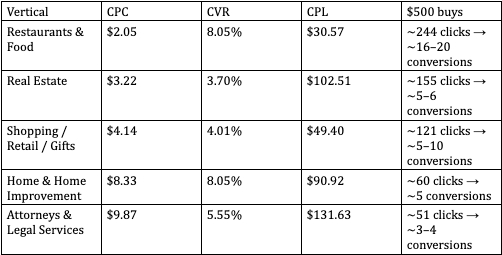
In the last column, one number means the click-based and cost-per-lead math agree. A range means they diverge, which the next paragraph explains.
For example: a Pilsen taqueria running $500 a month can get somewhere in the range of 16 to 20 conversions with a real shot at learning something from their data. An Orland Park HVAC company can get about five. A personal injury firm can get three or four leads, at over $130 each, from an entire month of spend.
When those two methods disagree (legal, for instance, comes out at 2.8 conversions counting by clicks and 3.8 counting by cost per lead), the gap is normal, not an error. The two use slightly different WordStream data, and at small numbers the difference shows up more. The takeaway for your own budget: expect your real numbers to wobble around these averages, so treat them as a starting range, not a promise.
The retail media exception
Retail media is the exception to all of that.
It means ads on a retailer’s own site, like Amazon’s sponsored listings, Walmart, or Chewy. Skai’s Q2 2026 Digital Marketing Quarterly Trends report covered roughly a trillion impressions and $10 billion in tracked spend. It found retail media's cost per click held near $1.00 for its seventh consecutive year. For context, Amazon Sponsored Products has a documented minimum daily budget of $1, which is consistent with the study.
At roughly a dollar a click, $500 buys about 500 clicks, five times the volume of Google Search. If you sell physical products on Amazon and your catalog is narrow enough that 500 clicks concentrate rather than scatter, this is the most efficient use of $500 among everything covered here.
That’s not a general endorsement of Amazon. It’s a specific observation about what a low CPC floor can do with a small budget.
Ask yourself these questions
- Do you know your actual cost per lead, or are you working from an industry average?
- At your vertical’s numbers, how many conversions does your current budget produce in a month?
- Is that enough data for you to tell a good week from a lucky one?
Why the algorithm can’t learn from $500
At $500 a month, you can’t feed the platform’s automated bidding enough conversions for it to learn, and that changes what you should do with the money.
Modern ad platforms don’t really let you buy clicks anymore. They let you hand over an objective and a budget, and their machine learning decides who sees your ad, when, on which platform, at what bid. That system needs a steady flow of conversion events to learn from. Starve it and nothing warns you. With only a handful of conversions a month, it can’t tell a real pattern from a few unrelated clicks that happened to land, so it guesses, often toward the wrong audience, while the dashboard still shows confident-looking numbers.
Google states its threshold openly. From its Smart Bidding documentation: “Google Ads recommends measuring performance over longer time periods that have at least 30 conversions, such as a month or longer (50 conversions for Target ROAS).”
Hold that against the math above. Blended, $500 a month produces about 7.5 conversions. That’s a quarter of what Google says it needs to evaluate the results. Home services and legal fall further short still, at about five and three-to-four conversions a month.
Meta’s version of this is the learning phase, the stretch right after you launch or significantly edit an ad set. During that window, delivery is unstable while the system gathers data. The widely repeated figure is that an ad set needs roughly 50 optimization events, meaning conversions the system is trying to get more of, in a seven-day window to exit it.
Meta’s 50-event threshold works the same way Google’s 30 does. It’s 50 of whatever conversion you’ve told the platform to optimize for, and it has been Meta’s rule of thumb for years.
The takeaway under all these numbers is simple, at $500 a month you can’t give the algorithm enough conversions to learn, so it optimizes on guesses. That isn’t a reason to give up. It’s the reason the next choices, which platform, which bidding, how long you wait, matter so much.
What that actually means for you
Three things to do about it.
Automated bidding is the wrong default at this budget. Target CPA and Target ROAS, where you set a target cost per result or return and let the algorithm chase it, need volume you don’t have. Manual CPC, where you set your own bid per click, or maximize clicks with a tight cap, gives you control over spend that the algorithm can’t earn at seven conversions a month.
Spend your budget all in one place. The instinct at $500 is to split it: a bit of Google, a bit of Meta, a bit of Instagram. That’s the worst possible move, because it pushes every individual campaign further below its platform’s viable learning volume. Pick one channel. Fund it properly.
Give your campaigns time before you judge it. At five to eight conversions a month, two weeks rarely tells you much on its own, though a genuinely bad start can still mean a weak ad. Check every couple of weeks and make only small tweaks, and save bigger changes for monthly. Know the platform too, Google lets you adjust with little penalty, while Meta often resets its learning phase on even minor edits. Give a channel about three months before you draw a firm conclusion.
One more number falls out of this. Put Google’s 30-conversion bar together with the $66.69 average cost per lead, and a trustworthy first read on Google Search works out to roughly $2,000 a month.
But isn’t some advertising better than none?
Some advertising is better than none, but only if it’s enough to learn from. Below that line, spending isn’t a smaller version of working. It’s a different activity that happens to produce the same-looking dashboard.
The reason this feels wrong is the story you’ve heard from someone who made $500 work. Those stories are real. They’re also the survivors. For every founder whose $500 Amazon test found a winning product, there are ten whose $500 got split across Google and Meta, returned four leads, and taught them nothing, and you never hear from those ten. Reasoning from the one success you were told about is how small budgets get set on fire.
The question isn’t whether $500 can work for someone. It’s whether your $500, in your vertical, at your numbers, clears the learning bar these platforms set. If it does, fund that one channel completely. If it doesn’t, the money usually does more in organic SEO, or waiting until the budget is real.
Where $500 genuinely works
Three places, with the reasoning.
Amazon Sponsored Products on a narrow catalog. Covered above. The $1 daily minimum plus a CPC that’s held near $1.00 for seven years means $500 could potentially buy about 500 clicks, and the product listing does the job of a landing page. This is the strongest fit for a business that sells physical goods on Amazon.
Google Local Services Ads, if you qualify. These are the ads with the green checkmark at the very top of local service searches, and they work differently from everything else here. Google’s documentation states: “With Local Services Ads, you pay for valid leads.” You set a weekly budget and a maximum bid per lead, and Google doesn’t charge you for leads it deems invalid. That structure protects a small budget from wasted clicks in a way cost-per-click search fundamentally can’t. The catch is qualification: license verification, insurance, background checks, and a properly connected Google Business Profile.
Branded search and tight retargeting. Branded search means ads that show when someone searches your business name. Retargeting means ads aimed at people who already visited your site. Both work at small budgets because they target people who already know you, and conversion rates on those warm audiences run far above cold prospecting, which is advertising to people who’ve never heard of you. The same $500 usually produces more sales here, because warm audiences convert better than cold ones. That read comes from the conversion-rate data rather than a separately benchmarked number, so treat it as directional.
Where $500 does not work: legal and home-services search on automated bidding, anything requiring video production, connected TV tests, and any plan that splits the budget across three or more platforms.
The management question nobody asks
If you’re considering paying someone to run a $500 budget, do this math first.
Typical agency pricing for small account management runs around $250 to $1,500 a month flat. Percentage-of-spend models generally sit at 10% to 20%. At 15% of $500, that’s $75, well below any agency’s flat minimum, which is exactly why small accounts get priced on flat fees.
So on a $500 budget, management can cost as much as the ads. Those pricing figures are agency self-reported rather than audited, so treat them as directional, but the basic problem is real. It’s a good reason to either start lean and run it yourself or grow the budget before bringing in help, and a straight agency will tell you which.
Frequently Asked Questions (FAQs)
Is $500 a month enough for Google Ads?
It’s enough to generate real activity and not enough for Google’s automation to evaluate it reliably. At the 2026 US average of $5.42 per click and 8.18% conversion rate, $500 produces roughly 92 clicks and 7 to 8 conversions a month. Google’s own Smart Bidding documentation recommends measuring over periods with at least 30 conversions, and 50 for Target ROAS. So the budget works if you scope tightly, use manual bidding, and judge results over a quarter rather than a week.
What’s the actual minimum spend on the major ad platforms?
The documented minimums are low and misleading. Amazon Sponsored Products and Sponsored Brands run on $1 a day, with Sponsored Display requiring no minimum. Snapchat is $5 a day. LinkedIn is $10 a day. TikTok requires $50 at the campaign level and $20 at the ad group level. Spotify Ad Studio requires $250 per campaign and Roku $500. Google Ads, Microsoft Advertising, and Pinterest publish no dollar minimum at all.
Which platform gives the most volume for $500?
Amazon Sponsored Products, if you sell physical products there. Retail media cost per click has held near $1.00 for seven consecutive years according to Skai’s Q2 2026 report, which means $500 buys roughly 500 clicks, about five times what blended Google Search delivers at $5.42 per click. Your product listing also serves as the landing page, removing a cost most other channels require.
Should I split a small budget across several platforms?
No. It’s the most common and most damaging instinct at this budget level. Every ad platform’s automated delivery system needs a minimum flow of conversion events to optimize, and splitting $500 three ways pushes each individual campaign further below that floor. You end up with three campaigns that all look like failures rather than one that produces enough signal to evaluate.
Is it worth paying an agency to manage $500 a month?
At exactly $500 the math is tight. Agency flat fees for small-account management typically run $250 to $1,500 a month, and a percentage-of-spend model on $500 comes to about $75, below most minimums, so management can rival the media spend. Those figures are agency self-reported rather than independently audited. The point isn’t to skip help; it’s that the first useful conversation is whether to start lean or grow the budget, which is exactly the call a good agency makes with you rather than just taking the fee.
What should I do if $500 is genuinely all I have?
Pick one channel and fund it completely. If you sell products on Amazon, run Sponsored Products. If you’re a licensed local service business, get through Local Services Ads verification, because pay-per-lead, where you’re billed only when a lead arrives rather than for every click, structurally protects a small budget. Otherwise run tightly geo-targeted search on your highest-intent terms, with manual bidding. Install conversion tracking before you spend a dollar, so the platform knows when someone actually converts. And commit to judging it after three months rather than three weeks.
Relevant Topics:

Dash Sze
Adotme Copywriting Team
"I write strategic content that drives traffic, converts audiences and scales brands."