Back to posts
Off Season Marketing for Contractors in Chicago

Dash Sze
10 min read
Oct 30, 2026

Overview
For Chicago contractors whose work depends on workable weather, the slowdown is familiar. The phone runs hot from April through October, then calls taper as temperatures drop and outdoor projects get harder to schedule. Landscaping, concrete, decks, fencing, and exterior painting feel the slowdown most; roofers may still have emergency work, but many non-emergency projects get pushed back. Owners often respond the same way. They cut marketing, park the trucks, and wait for spring.
That’s the mistake. Not because winter is secretly busy, but because marketing often pays off on a delay. The SEO work you do in December may not produce a lead that month. It gives your pages more time to earn visibility before spring, when the homeowner who’s been staring at a sagging gutter all winter finally searches for a roofer. Being visible then gives you a chance to be considered before the homeowner chooses a contractor.
Go dark in January and you’re not saving money. You’re handing your spring to the competitor who stayed visible.
This is a Chicago playbook for the slow months, built around two things you can influence when demand drops. The first is the search visibility you build before spring. The second is the set of assets that take time to accumulate, like recent reviews, booked jobs, and relationships with past customers. Winter shouldn’t be just your downtime, it should be used as preparation for the next season.
Quick Answer
How do seasonal contractors keep leads coming in during the off-season?
Demand for most outdoor trades is weather-dependent, slowing in winter and picking up as spring conditions return. Google rankings can take time to develop, so winter is an opportunity to build content and strengthen your business profile before spring demand returns. Bank recent reviews, book spring jobs with deposits now, and reach out to past customers while competitors go quiet. Judge the season by spring work booked and pipeline built, not by January lead count.
The Winter Lead Drought Is Real
Demand for weather-dependent outdoor work typically slows in winter and picks up as conditions improve in spring. Landscaping installations, exterior painting, decks, and concrete are especially weather-sensitive, while emergency roofing and some winter services can still generate calls. In Chicago, that slowdown can stretch across several months.
Chicago averages 38.4 inches of snowfall a year, according to the National Weather Service’s 1991–2020 climate normals, with the highest monthly totals in January and February. For weather-dependent contractors, that can mean several months when outdoor work is constrained and projects have to wait for better conditions. The demand isn’t always gone; a lot of it is just delayed until conditions improve.
Here’s the trap that creates. When the calls stop, cutting marketing feels like the correct move. You’re protecting cash in a lean stretch. It reads as smart, but it's actually the most expensive quiet you’ll ever buy.
The costs will show up later. If you stop improving your pages, collecting reviews, and following up with past customers, you’ll make it to spring with weaker visibility and a thinner pipeline than your competitors who kept working through the off-season.
There’s a Chicago-specific opportunity hiding in the drought, too. Winter can create or expose problems that become spring repair jobs. Repeated freezing and thawing can worsen cracks in concrete and masonry as trapped water expands, and on roofs, melting snow that refreezes at colder roof edges can contribute to ice dams and drainage problems. Some homeowners notice the damage in winter but postpone non-urgent work until spring, which gives you a window to educate them and be the name they already recognize when they’re ready.
Winter Is When You Build the Ranking That Sells Spring
Ranking on Google can take time, and that uncertainty is exactly why winter matters. Some pages break through within weeks, but many never reach the top ten, and the results that dominate it tend to be well-established. Ahrefs found that 72.9% of the pages in its sampled top-ten results had first been seen by its crawler more than three years earlier. That doesn’t mean every new page takes years to rank, but it shows how established the top results can be. You cannot microwave search visibility in March.
That lag is a gift if you time it right. Publish in November or December and a page has several months to be discovered, indexed, and earn visibility before spring demand returns. Wait until the season starts and you leave less time for that to work while the early-season opportunity is already underway. The off-season isn’t a break from SEO. It’s the head start that lets a page mature before spring brings in the returns.
So what do you actually build in those months? Start with the pages that answer what your spring customer will Google. A Tinley Park roofing crew should spend winter writing the plain, useful pages a homeowner searches in a panic — what ice dams do to a roof, how to tell hail damage from normal wear, what a tear-off actually costs in the south suburbs. These aren’t ads. They’re the questions people type before they’re ready to call, and a page that answers them puts your company in the running before the homeowner is ready to pick up the phone. That’s the compounding potential of organic SEO. A useful page can keep attracting relevant searches long after publication, as long as it stays useful and competitive. Don’t build the plan around blog posts alone, though. Where it makes sense, link each article to the relevant service page, so readers can see your work, understand your process, and request an estimate. The article answers the question; the service page gives an interested customer a clear next step.
Keep your Google Business Profile current while you’re at it. It’s the listing Google uses to represent your business in Google Maps and local search results. For a query like “concrete contractor near me,” your profile may appear in the prominent group of local business listings. Google says local results are mainly based on relevance, distance, and popularity, and that complete, accurate business information helps it match your profile to relevant searches. Keep your services and hours current, make sure the listing reflects the work you actually do, and add genuine project photos where relevant. Accurate information helps Google understand your business, and current photos help a prospective homeowner judge your work once they find you. Our Holiday Local SEO guide for Chicago goes deeper on the profile and review signals behind local search visibility.
There’s a paid version of this same timing play. When competitors pull back on winter advertising, some campaigns may reach qualified prospects at a lower cost, though that varies by market and auction, so check your own campaign history first. You’re not chasing a flood of leads in January. You’re reaching a smaller pool of high-intent planners — the one quietly pricing a spring reroof, the homeowner researching a deck for May — at a cost the eventual job can support.
Bank What Spring Can’t Buy: Reviews, Booked Jobs, and Past Customers
Some things you can’t rush the week you need them, and the off-season is when you stock up. Reviews are the clearest example. Whitespark’s 2026 Local Search Ranking Factors survey identifies reviews as an important part of local SEO, with practitioners weighing review recency and a steady influx of new reviews alongside review quantity. These are practitioner assessments, not confirmed ranking weights from Google.
That changes when you should be asking. A review you earn in January gives your profile more recent feedback heading into April; a review you scramble for in May gives you less lead time. Start with customers whose jobs you completed in the fall, while the work is still fresh in their minds. Respond to each one, too. Not because every reply moves rankings, but because your profile is half search result and half sales page, and a thoughtful response shows the next customer that someone’s paying attention. Read what the reviews keep saying, while you’re at it. Repeated themes — fair pricing, a clean worksite, or showing up when promised — tell you what customers value. Use those recurring themes to make your service pages more specific to what customers actually care about.
The second thing to bank is the spring schedule itself. You don’t have to wait for spring to sell spring. Off-season is the ideal time to book work onto a calendar that doesn’t exist yet, because the planners are already out there pricing projects, and a modest deposit holds their spot. A homeowner who commits to an April patio pour in January gives you a booked job before the busy season begins. Put the agreed scope, deposit terms, and a weather-related rescheduling policy in writing, so you’re reserving profitable spring capacity rather than filling the calendar with commitments you can’t reliably deliver. Preparing estimates, agreeing on scopes, and collecting deposits are winter work. The trucks roll in spring, but the deals close now.
Then there are the customers you already have, often one of the most cost-effective audiences to start with. They know your work and may already trust you; they just need a timely reason to book again. You’ve already invested in earning their business, so reaching them again is usually less expensive than acquiring a new customer. A short seasonal note — book your spring cleanup, schedule the deck stain before the rush, or use this winter-damage checklist — helps customers remember your business when they’re ready to book again.
You can stretch that same list further with retargeting, which means showing ads to people who’ve already visited your website or engaged with you before. If your site draws enough relevant traffic and the tracking is set up properly, retargeting can keep your business in front of those visitors as they plan their spring projects. Start with a controlled budget and compare its cost per qualified lead against search ads and past-customer outreach before you spend more.
One more move worth considering is the off-season pivot. Many Chicago contractors add a winter service that fits their crew and equipment: snow and ice removal, gutter and ice-dam work, interior projects for exterior contractors, or planning and design services for landscaping businesses. The best winter pivot uses skills, equipment, and insurance you already have in place. Not every exterior crew can safely take on ice-dam removal. A pivot keeps revenue moving and gives you something current to market while you’re building for spring. An Orland Park landscaper selling winter cleanups and spring-design consultations isn’t sitting idle. For a look at how consistent seasonal marketing compounds for a lawn care operation, our Premier Lawn Care project is a working example.
The Same Winter, Different by Trade
The timing logic is the same for every outdoor trade, but what you build in the slow months depends on how your trade makes money.
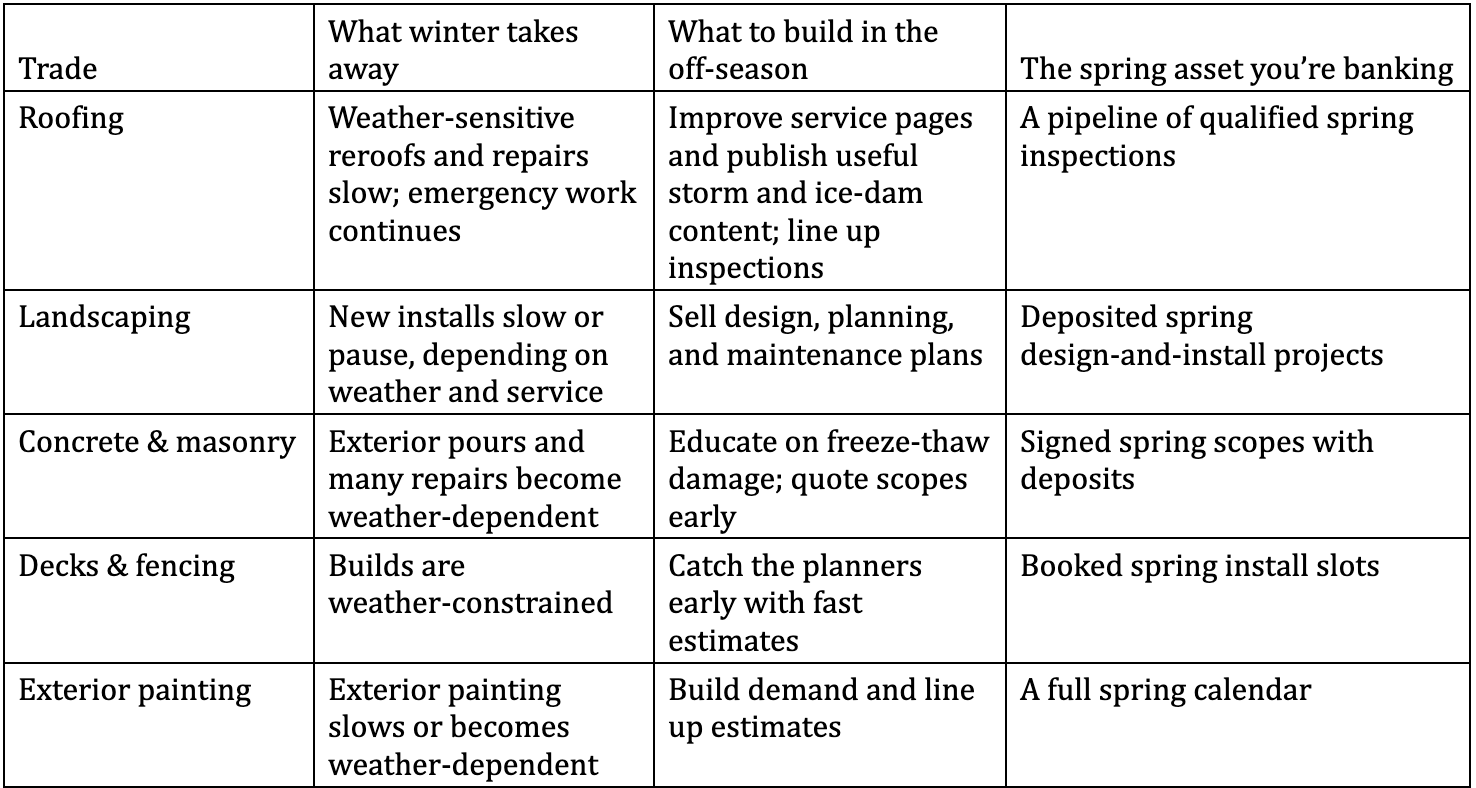
The Same Winter, Different by Trade
Read your own trade across the row. The engine stays the same: visibility, reviews, pipeline, and past customers. The priority you build around in December depends on the trade.
Your Off-Season, Month by Month
The thesis is simple; here’s what it looks like on the calendar.
- November — prepare before the slowdown. Review which services and channels generated profitable work, organize your past-customer records, find the gaps in your service pages, and ask customers from recently completed jobs for reviews.
- December — strengthen the foundation. Improve your core service pages, update the Google Business Profile, add genuine project photos, and set a baseline for leads, estimates, and booked work.
- January — start selling spring. Publish supporting articles that answer pre-purchase questions, open spring estimates and bookings, and contact past customers with relevant seasonal offers.
- February — move the pipeline forward. Follow up on open estimates, resolve unanswered questions, request reviews, and test retargeting if the audience is large enough to justify it.
- March — convert the returning demand. Keep availability accurate, respond promptly to inquiries, close outstanding estimates, and make sure the spring schedule has enough profitable work.
None of these tasks has to dominate a single week. The point is steady progress each month, so you reach spring with stronger service pages, recent customer feedback, a healthier pipeline, and ideally some jobs already booked.
Fill Spring Capacity, Not a January Lead Count
Lead volume alone is a poor winter scoreboard. A quiet January inbox doesn’t mean your marketing failed, and a flood of January inquiries nobody closes doesn’t mean it worked.
What you’re really doing over the winter is filling next season’s calendar with profitable work. A roofer with four crews and twenty good weeks doesn’t need the highest possible lead count; they need enough qualified, well-priced jobs to keep those crews busy at a margin worth the drive. So the better questions in January aren’t “how many leads came in” but “how much spring work did we move forward” and “how much of it is already booked.”
Picture two contractors. The first gets 30 January leads, turns eight into estimates, and books 3 spring jobs worth $36,000. The second gets 60 leads, writes seven estimates, and books 1 job worth $9,000. The second looks busier on a lead report but has booked far less work by contract value. Job margins and marketing costs still matter, but a lead count alone clearly doesn’t tell the story. Track booked contract value and expected gross margin, the value of open estimates, and the rate at which quotes become jobs. Alongside those outcomes, track how many new reviews you earn, how many past customers return, and how quickly you respond to inquiries.
That last one matters more than most contractors admit. A lead is only worth what you do with it. If calls go to voicemail, estimates take a week, and nobody follows up, the best winter marketing in the county still leaks out the bottom. Marketing fills the top of the pipe; your response speed and your estimate-to-close process decide how much of it turns into booked work. The fix is to set a response standard you can reliably meet: acknowledge new inquiries within an hour during business hours, give a realistic estimate timeline, and schedule follow-ups instead of leaving them open-ended. The slow season is when you finally have time to tighten that, which is part of why it’s worth using.
It also tells you what to change as the calendar fills. If spring is empty, lean into visibility and acquisition. If the pipeline is healthy, shift toward nurturing and pre-booking the planners you’ve already reached. If spring capacity is nearly full, stop chasing leads you can’t profitably serve and start building demand for later in the season or next fall. The goal isn’t to keep every campaign running forever. It’s to adjust your marketing to the work you still need to book.
Winter is the wrong time to disappear and the right time to build. Adotme helps contractors across Chicago, Tinley Park, and Orland Park strengthen their content and organic search visibility ahead of next season’s demand. Explore our content marketing and organic SEO services, or read our guide to how small businesses can afford professional SEO.
Frequently Asked Questions (FAQs)
Should contractors stop marketing in the winter off-season?
Not necessarily. The right move isn’t to keep every campaign at the same budget all winter; it’s to protect the work that supports spring visibility and bookings. Keep service pages current, collect genuine reviews, follow up with past customers, and adjust paid spend to what the numbers justify. Going dark completely in January can leave you with less time to build visibility and pipeline before demand returns.
What marketing actually works for contractors during the slow season?
The core tactics are search content that answers your spring customers’ questions, an accurate Google Business Profile, recent reviews, and spring jobs booked with deposits. Reaching out to past customers helps too. Paid ads are a conditional add-on, since some campaigns may cost less as competition changes, though that varies by market, so check your numbers first.
How long does SEO take to work for a contractor website?
It varies more than most people expect. Some pages climb within weeks; many never reach the top ten at all, and the results that rank tend to be well-established. You can’t schedule a ranking for April, so winter timing helps by giving a useful page months to be discovered and earn visibility before spring demand returns.
How do I book spring work during the winter?
Make estimates easy to request and follow up on open quotes. Where it fits, take a deposit under written terms covering scope, scheduling, and weather delays, and reach out to past customers with spring offers before the busy season begins.
Relevant Topics:

Dash Sze
Adotme Copywriting Team
"I write strategic content that drives traffic, converts audiences and scales brands."