Back to posts
Founder Ads: Why Phone Videos Beat $10K Commercials

Dash Sze
10 mins read
Aug 28, 2026
Overview
You probably know by now that a commercial can get expensive fast. Finding a studio, getting the lighting right, hiring a crew, then paying to have it all professionally edited — that adds up to a five-figure project in a hurry. And the final result usually looks incredible.
But there’s a problem.
People can tell when they’re watching an ad. And the second something feels like an ad, they’re far more likely to scroll right past it. After fifteen years of advertising in every corner of their feed, consumers have trained themselves to skip anything that looks promotional. A glossy, over-produced commercial is one of the clearest “this is an ad, keep scrolling” signals there is.
Even the platforms are telling you to stop. TikTok’s advice to brands is literally “Don’t Make Ads. Make TikToks.” Meta tells advertisers straight up that they “don’t need a large budget or professional training,” and to just “use your phone.”
So why spend thousands trying to make your content look like an advertisement, when the companies that own the feed are telling you the stuff that works looks like a normal person made it?
Here’s the part most agencies won’t say out loud, because they’re the ones selling the $10k shoot. The reason to switch isn’t only that studio ads got pricey, though on Meta they did. It’s that the one lever you actually control is the creative itself, and every platform’s own data points the same way: raw, native, founder-led video wins. It’s the same logic behind picking the right ad platform in the first place.
So let’s make the case with the platforms’ own numbers, then get practical. By the end you’ll have the 4-part founder script and the iPhone shoot playbook, and you’ll be able to make your first one this afternoon.
Why Slick Studio Commercials Are Failing DTC Brands
The problem with a polished commercial isn’t that it looks bad. It probably looks great.
The problem is that it looks like an ad.
Consumers have spent years surrounded by advertising, and they’ve gotten very good at ignoring anything that feels promotional. On TikTok, Instagram, and Facebook, you’re competing against content that feels natural and personal, so a highly produced commercial stands out for exactly the wrong reason.
The money you save by skipping the big production is nice. But that’s not really the point. The bigger problem is that your $10,000 commercial doesn’t matter if nobody sticks around long enough to watch it.
So what should you do instead? Make content that feels like content.
The Scroll-Past Problem
People don’t consciously decide to skip your ad. They’ve simply learned not to see it.
Researchers even have a name for it: banner blindness. The Nielsen Norman Group, which has run eye-tracking studies on it for decades, calls banner blindness “a strong and robust phenomenon” documented “across 3 decades.” In one test, an ad-shaped element pulled attention “33 times smaller than its size might have warranted.”
The lesson has nothing to do with ads not working. It’s that the signals around them matter. Perfect lighting, a logo mockup, a tagline, stock-music — the familiar ingredients of a commercial — can tell someone what they’re looking at before your message even starts.
A founder talking into their phone doesn’t carry those signals. Neither does a customer filming an unboxing or a creator explaining why they use something. The format feels native to the environment, so it earns a chance at attention before it asks for anything.
That’s the real thing brands are chasing with creator-style content. Not lower production value. Lower resistance.
Why the Algorithms Reward Native-Looking Content
This isn’t a hack you’re pulling on the platforms. It’s exactly what they’re openly telling you to do.
TikTok built a whole brand philosophy around it, summed up in the line “Don’t Make Ads. Make TikToks,” which it describes as “an invitation to be more creative, more authentic.” Its own guidance is blunt: “Less polished, but real life and authentic content works best.”
Meta says much the same thing. Its mobile-first creative guidance tells brands to “go beyond just repurposing a TV spot on mobile,” while its help docs tell advertisers they “don’t need a large budget or professional training to make creative Meta ads.” If you don’t have much equipment, Meta’s advice is simple: “use your phone.”
That’s an important distinction. The polished commercial was built to stand apart from everything around it. Native content is built to fit in.
So when the companies selling the ad space are this direct about what works, the polished-commercial habit isn’t just expensive. It’s fighting the platform.
The Cost-Per-Acquisition Reality Check
Here’s where most versions of this argument overreach, so let’s be accurate.
The story isn’t “CPMs are exploding everywhere.” CPM, which is what you pay each time your ad gets shown a thousand times, actually fell on TikTok year over year in early 2025. On Meta, though, costs genuinely climbed. Meta’s own 2025 earnings report states that its average price per ad rose 9% year over year for the full year, while one large benchmark of US lead campaigns found the average cost per lead jumped roughly 21% in a year.
Media prices move around. Platform by platform, quarter by quarter, they change.
What doesn’t change is the importance of the creative itself. Nielsen’s advertising research has long identified creative as the single largest driver of a campaign’s sales impact, historically crediting it with the majority of ad-driven sales lift. Meta puts a sharper number on it, attributing 56% of a campaign’s sales lift to the quality of the creative.
That should change how you think about production.
If more than half your result can ride on the creative, spending your whole budget on one polished asset you hope works makes little sense. You’re better off making more variations, testing more ideas, and letting the winners earn the budget.
The goal isn’t to make one perfect ad.
It’s to find what works.
Ask Yourself These Questions
- When did you last stop scrolling for an ad that looked like an ad?
- Are you optimizing the thing platforms say matters most (the creative), or the thing you can’t control (the auction price)?
- If your best-performing organic post is a raw phone video, why does your paid creative still look like a TV spot?
Why Raw Founder Videos Build Instant Trust
A founder video works because it brings two things to the screen a commercial can’t manufacture: a real person, and a real reason the product exists.
People trust people more than they trust brands. A founder on camera collapses the distance between “a company selling me something” and “a person telling me why they made this.”
There’s also something harder to fake about a founder explaining their own product. They know the problem because they lived it. They can tell you why they built the thing, what wasn’t working before it existed, and what they actually believe makes it different.
That context gives the viewer a reason to care beyond the product itself.
And that’s the real value of founder content. It doesn’t just make the brand feel human. It gives people a reason to keep watching.
Direct-to-Camera and the Authenticity Signal
When a founder looks into the lens and talks to you, it feels like being spoken to rather than advertised at. That direct address holds attention and signals something simple: this is a person, not a production.
Be careful how you sell this internally, though, because the pop-psychology version gets it wrong. Eye contact isn’t a persuasion cheat code.
The research is genuinely mixed. One study found people were more likely to believe a speaker who looked directly at them. Another, published in Psychological Science, found that more eye contact can actually make people dig in harder against a message they didn’t already agree with.
So the founder-to-camera advantage isn’t mind control. It’s attention and authenticity.
It earns the watch. It lowers the feeling that someone’s trying to sell you something. What happens after that is up to the product and the rest of the creative.
The Origin-Story Effect
The strongest founder ads don’t open by selling a product. They open with a problem the founder personally had.
“I have sensitive skin and every sunscreen I tried left a white cast, so I spent two years formulating one that didn’t” is a fundamentally different message than “Introducing our revolutionary new SPF.”
One is a person solving their own problem. The other is a company moving inventory.
That framing matters because it answers the question every skeptical buyer is silently asking: why should I believe you?
A founder who built the product to fix their own frustration already has an answer. They’re not a spokesperson reading lines. They’re the reason the product exists.
And that’s a kind of credibility a studio budget can’t buy.
Disarming Skepticism in the First 3 Seconds
You don’t get fifteen seconds to earn trust. You get about three.
Meta’s creative guidance is explicit: “get your main message across in the first 3 seconds.” TikTok’s data shows roughly 90% of an ad’s recall impact lands within the first six seconds. Whatever trust you’re going to build, you have to start before most viewers have decided whether to keep watching.
This is where the founder format has an edge. Trust in a real person transfers faster than trust in a brand. Nielsen’s global trust research has consistently found that people trust recommendations from other people far more than brand advertising — in its widely cited survey, 83% trusted friends and family, and about two-thirds trusted other consumers’ opinions posted online, both well above trust in ads.
A founder’s face in the first three seconds borrows a little of that people-trust before the pitch even starts.
A logo animation borrows none of it.
The Math: Creative Velocity Beats Production Budget
The financial case for founder ads isn’t really about saving money on production. It’s about what that saved money buys you: attempts.
A $10,000 commercial is one expensive guess. The same money spread across founder videos gives you dozens of chances to test different hooks, messages, and formats. And in a channel where you can’t call the winner in advance, more attempts give you a much better shot at finding one.
One $10k Bet Versus Ten $0 Iterations
Nobody, including the best media buyers alive, can reliably predict which creative will win before it runs. That’s the whole game.
So the smartest strategy isn’t to make one perfect ad. It’s to make many rough ones, put them in front of the algorithm, and let the results pick the winner.
A studio shoot might give you one or two finished variations for your money and your calendar. A founder with an iPhone can shoot five or ten different hooks for the same product in an afternoon, at essentially zero marginal cost.
When you can only afford one swing, you’d better be right. When you can take ten swings for free, you don’t have to be right.
You just have to test.
What the Platforms’ Own Data Says About Volume and Refresh
This isn’t a contrarian opinion. It’s what the platforms measure and publish.
TikTok’s own analysis found that campaigns running five to seven creatives delivered roughly a 1.5x performance advantage over campaigns running fewer, while refreshing creative weekly lifted conversions 10 to 12%. Meta’s December 2025 guidance pushes advertisers toward “creative diversification,” making ads that are “truly different in look, feel, storyline, and message” rather than minor tweaks.
Meta also warns about creative fatigue, which is what happens when an audience is overexposed to the same creative, leading to declining engagement and higher costs. Think of a joke that stops being funny the fifth time your audience hears it.
Read those together and the conclusion is straightforward. Platforms reward volume and variety. A single studio commercial gives you almost no room to experiment before you have to spend again.
Founder content gives you the opposite.
You can always shoot more.
Studio Production Versus Founder-Led Ads, Side by Side
Here’s the comparison in one view. Treat the dollar figures as illustrative ranges, not quotes. Production benchmarks for a professionally made brand video typically run somewhere between about $1,000 and $16,000 per finished piece, while a founder phone video’s marginal cost is close to nothing.
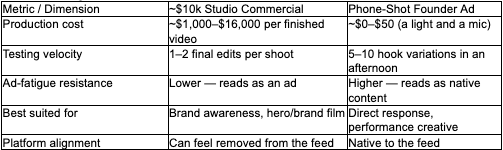
Studio Ads vs Founder Ads
The studio spot still has a place. If you’re building a brand film for the homepage or a broad awareness push, produce it properly.
But for direct-response ads, the ones whose only job is to earn a click and a sale at a cost that works, founder content gives you something the studio shoot can’t:
More chances to find what works.
But Won’t Founder Ads Cheapen a Premium Brand?
This is the objection every high-end founder raises, and it comes from confusing two different jobs.
A top-of-funnel conversion ad is not your homepage. Its job is to stop the scroll and earn the click. The place you build a premium feel is everything that happens after that: the landing page, the unboxing, the packaging, the product itself.
A raw founder video in the feed doesn’t take any of that away.
If anything, it makes the destination feel more considered. The ad gets someone interested. The brand experience gets them impressed.
Keep the ad honest, and let the destination carry the luxury.
The 4-Part Founder Ad Script Blueprint
A founder ad isn’t improv. It’s a loose script with four jobs, timed to how people actually watch: hook them, make the problem real, show the product working, and give them one easy next step.
Aim for 30 to 45 seconds total.
Part 1 — The Pattern-Interrupt Hook (Seconds 0–3)
The first three seconds decide everything, so lead with the single most surprising, specific, or useful thing you can say.
Skip the intro. Don’t say your name or your brand yet.
Open on a claim, a problem, or a result: “I threw out every moisturizer in my bathroom after I learned this,” or “This is the mistake that was wrecking your sourdough.”
The job of second one is to make second four happen.
A good test: if your first line would still make sense as the opening of a text to a friend, it’s a hook. If it sounds like a voiceover, rewrite it.
Part 2 — The Agitation and Personal Origin Story (Seconds 4–15)
Now that they’re watching, make the problem real and explain why you’re the one talking about it.
This is where the origin story does its work. “I have eczema, and every ‘gentle’ cleanser still left my skin raw, so I started reading ingredient labels obsessively” establishes both the problem and why you built the product.
Keep it concrete and a little vulnerable. The specifics are what make it believable.
Part 3 — The Raw “Show, Don’t Tell” Product Demo (Seconds 16–30)
Stop talking about it and show it.
Pour it, swatch it, wear it, use it on camera. Let the product do the explaining wherever you can.
A real demo that feels like a friend showing you something beats a glossy product shot, because the whole premise is that this is real. If there’s a visible before-and-after, an oddly satisfying texture, or a moment where the product obviously does the thing, make that the center.
Part 4 — The Low-Friction Call-to-Action (Seconds 31–45)
End with one clear, small next step, said like a person rather than a billboard.
“I’ll leave a link. The starter set is the cheapest way to try it” beats “Shop now at our website.”
Give them one action, and where you can, lower the perceived risk with a starter size, a guarantee, or free shipping.
Then stop.
The Hook Matrix: How to Get Ten Ads From One Shoot
This is where the velocity argument stops being theory.
Once you have a body that works, you don’t need to reshoot the whole thing to test a new idea. Keep the demo and the CTA the same, and reshoot only the first three seconds.
Five different openings over the same body gives you five ads in a single sitting.
Try different angles:
- Problem-first: “Stop using [product] if you have [problem].”
- Us versus them: “Why the [category] you’ve been buying is quietly ripping you off.”
- Visual pattern interrupt: Do something unexpected as you start talking.
- Behind the scenes: “Ten manufacturers turned me down before this existed.”
- Direct question: “Struggling with [problem]? Watch this.”
Shoot them back to back, push them live, and let the results tell you which opening wins.
One afternoon becomes a month of testing, and the winning hook is usually one you wouldn’t have bet on.
How to Shoot a High-Converting Founder Ad on Your iPhone
You already own the camera.
A modern iPhone shoots sharper video than most commercials did a decade ago, so the gap between founder content and studio content isn’t the camera. It’s a few basics of light, sound, and framing that cost very little to fix.
Get those right and “shot on a phone” stops looking like “shot carelessly.”
Lighting and Audio: The Only ~$30 of Gear You Need
Two things separate watchable phone video from amateur phone video, and neither is the camera.
First, light. Face a window, or buy a cheap LED panel or ring light, and don’t let the brightest light sit behind you.
Second, sound. Phone microphones are fine from a foot away and much worse from three feet, so a small clip-on lapel mic — the kind that costs about twenty dollars — does more for perceived quality than any camera upgrade.
Viewers forgive imperfect footage.
They bail on bad audio.
Framing and Eye Level: Look Like a Friend, Not a Salesperson
Shoot vertically and fill the screen.
Both TikTok and Instagram Reels are built around a 9:16 vertical frame, which is just the tall shape you hold your phone in, and Meta’s own tests found that vertical video ads built for the format delivered a 34.5% lower cost per result than image ads.
Put the camera at eye level and look into the lens, not at your own face on the screen. That’s the difference between talking to someone and talking near them.
Keep your face and important text out of the corners, too. Platforms layer buttons, captions, and usernames over the edges of the frame, so use their published “safe zone” guides.
Native Editing: Captions, Pacing, and Keeping It Raw
Edit it to feel like it belongs in the feed, not a broadcast.
Add captions, always, because a large share of feed video gets watched with the sound off, and a silent viewer with no captions is a lost viewer. Cut every dead second, especially at the front, but don’t over-produce it. Skip the intro animation, the logo sting, and the background-music bed that screams “commercial.”
On TikTok, sound is part of the platform. TikTok says 88% of its users consider sound vital, so use real audio and let your voice carry the video.
The goal is simple: make something the viewer is interested in before they think about whether it’s an ad.
Common Pitfalls: When Founder Ads Flop
Founder ads fail in predictable ways, and almost always because the founder tried too hard to make “an ad” instead of trusting the format.
If your founder video didn’t work, it’s probably one of these three. All three are fixable without another shoot.
Pitfall #1 — Over-Scripting and Losing the Natural Delivery
The most common failure is a founder memorizing a script word for word and delivering it like a hostage reading a ransom note.
Stiff beats slick every time, but natural beats both.
Use the four-part blueprint as a set of beats to hit, not a teleprompter. Know your hook and first line cold, then talk through the rest like you’re explaining it to a friend.
Shoot a few takes. The one with a small stumble in it often beats the perfect version, because the stumble is proof it’s real.
Pitfall #2 — Spending the First 10 Seconds Explaining Who You Are
“Hey guys, I’m Jamie, founder of Acme, and today I want to talk about our new…”
And they’re gone.
You had three seconds, and you just spent them on an introduction nobody asked for.
Save your name and brand for after the hook has done its job. Lead with the problem or the result.
The viewer doesn’t care who you are until you’ve given them a reason to.
Pitfall #3 — Poor Captions and Ignored Silent Viewers
If a large share of your audience watches muted and your video has no captions, you’ve lost them by default.
Caption every founder ad and check the auto-captions for mistakes, especially around your product name. Then watch it with the sound off and make sure it still makes sense.
A video that only works with audio is a video that only works for a minority of the people who see it.
Ready to Put Founder Ads to Work?
Knowing founder ads win is the easy part. Building the system around them is the hard part, and it’s where most brands stall: a monthly slate of hooks, the testing structure that finds winners fast, and the media buying that scales them once they hit. That’s what we do. Our digital advertising team runs the creative-testing and scaling engine, and our social media marketing service helps founders build the content habit that feeds it. If you’ve got a product you believe in and a phone in your pocket, get in touch and we’ll help you turn one afternoon of shooting into a real performance channel.
External references: Don’t Make Ads, Make TikToks — TikTok for Business · Creative best practices for top-performing ads — TikTok for Business · Mobile-first creative — Meta for Business · Demystifying creative diversification — Meta for Business · Banner Blindness Revisited — Nielsen Norman Group
Frequently Asked Questions (FAQs)
What if the founder is too camera-shy to be on video?
You have options, and none of them require the founder to become an influencer. The founder can appear briefly just to deliver the origin story while the rest runs as voiceover over product footage. Or a trusted employee, or even a real customer, can front the ad instead, since the “person who solved their own problem” angle works from anyone authentic. You can also start with hands-only product demos and voiceover, which carry a lot of the same native feel. The magic is the authenticity, not a specific face, so use the most genuine person willing to be on camera.
Which ad platforms work best for phone-shot founder ads?
The vertical-video, feed-native platforms: TikTok, Instagram Reels and Facebook Reels through Meta, and YouTube Shorts. They’re built for 9:16 phone-shot content, and their algorithms favor native-style video, which is exactly what a founder ad is. TikTok skews sound-on and trend-aware, while Meta’s feed is often watched on mute, so caption everything and design the opening to work in silence. Start where your customers already spend time, then expand the winning creative to the other platforms.
How long should a DTC founder video ad be?
For direct response, aim for roughly 15 to 45 seconds, and get the core message into the first three. TikTok’s own recommendation for in-feed ads lands around 9 to 15 seconds for the tightest cut, and Meta advises making your point in the first three seconds and keeping many ads to 15 seconds or less. Longer can work when the story or demo earns it, but the discipline is the same at any length. Hook fast, show the product, and don’t waste the open on an introduction.
Do I need professional gear or editing software to shoot a founder ad?
No. A recent phone and good daylight already beat most studio work for feed ads. Shoot vertical near a window, cut the clip in a free app like CapCut, and add captions, since most people scroll feeds with the sound off. The one upgrade worth making is a small clip-on microphone, which runs about $20 to $30, because viewers forgive rough video far more than they forgive bad audio. The money you would have handed a production crew does more good as ad spend and as budget to test more hooks.
How do I know if a founder video is actually working?
Watch three numbers in your ads manager before you even look at revenue. The first is hook rate, which is the share of viewers who keep watching past the first three seconds and tells you whether your opening earns attention. The second is hold rate, which is the share who make it to the end and tells you whether the story holds them. The third is cost per result, which is what you pay for each purchase or lead and tells you whether the video actually sells. A clip can have a strong hook and still fail to convert, so read the three together. Cut anything with a weak hook rate quickly and move that budget into the winners.
Relevant Topics:

Dash Sze
Adotme Copywriting Team
"I write strategic content that drives traffic, converts audiences and scales brands."