Back to posts
ChatGPT Ads Are Here: What OpenAI’s 2026 Rollout Means

Dash Sze
10 mins read
Jul 26, 2026

Overview
For most of ChatGPT's short life, there was one thing both free and paid users had in common: neither experience included advertising. That changed in 2026. On January 16, OpenAI announced it would bring ads to ChatGPT, and on February 9 it began testing them with users in the United States.
This is the moment a lot of people quietly expected and nobody quite believed. ChatGPT has hundreds of millions of weekly users, most of whom pay nothing, and running that at OpenAI’s scale costs more than subscriptions bring in. Ads are how almost every free consumer product at that size eventually pays for itself. Google did it. Facebook did it. Now ChatGPT, the internet's favorite "Shoggoth" chatbot, is doing it too.
Here’s the problem. Most of what’s written about “ChatGPT ads” online is half fact and half fan fiction, complete with invented dollar rates and campaign specifics that don’t come from OpenAI. So, this is the clean version. Everything below comes from OpenAI’s own announcements, help center, and developer documentation. When OpenAI hasn’t said something, I’ll tell you it hasn’t said it, instead of guessing on its behalf.
Does ChatGPT have ads now?
Yes. OpenAI announced ads on January 16, 2026 and began testing them in the U.S. on February 9. Ads appear only for people on the Free and ChatGPT Go plans, as a single sponsored unit below an answer, matched to your conversation instead of a typed keyword. Paid tiers above Go stay ad-free, and OpenAI says ads never change the answer itself.
What OpenAI Actually Announced (and When)
OpenAI is testing ads inside ChatGPT, and it’s already live in a growing list of countries. The company laid it out in two posts, one on its approach to advertising and one tracking the test itself, both published on its own site. This isn’t a rumor or a leak. It’s OpenAI’s stated product direction.
The timeline is worth pinning down, because it tells you how fast this moved.
On January 16, 2026, OpenAI announced the plan and framed it around five principles, the headline one being that ads wouldn’t change the answers ChatGPT gives you. On February 9, 2026, testing began for real, with logged-in adults in the United States. On March 26, OpenAI reported the pilot had shown “no impact on consumer trust metrics” and expanded it to Canada, Australia, and New Zealand. On May 5, it opened a beta self-serve Ads Manager so advertisers could buy ChatGPT ads directly. And on May 7, the company said it planned to bring the test to the United Kingdom, Mexico, Brazil, Japan, and South Korea.
Which is crazy that in just under four months, ChatGPT ads went from an announcement to a live test across three continents, with a self-serve ad platform bolted on along the way.
Two words matter in all of OpenAI’s language here, and they pull in opposite directions. OpenAI keeps calling the consumer side a “pilot” or a “test,” still tuning it market by market. But it also shipped real advertiser tools fast, so the buying side is moving quicker than the “test” framing suggests. Both things are true at once, and it’s why some of the details below are still shifting.
Who Sees Ads — and Who Doesn’t
Ads only show up on the free end of ChatGPT, and OpenAI drew that line for the get-go. Ads may appear for people on the Free and ChatGPT Go plans. Everyone on Plus, Pro, Business, Enterprise, and Edu stays completely ad-free. If you pay for one of the higher tiers, nothing about your experience changes.
ChatGPT Go is the piece most people miss, so it’s worth explaining. Go is OpenAI’s cheapest paid plan, launched worldwide on the same day as the ads announcement, at $8 per month in the U.S. It gives you roughly ten times the free tier’s messages, file uploads, and image generations. And it still shows ads. So the ad-supported audience isn’t only the people paying nothing. It’s the free users plus the eight-dollar users, which is a very large pool of ordinary consumers who use ChatGPT every day.
There’s also an escape hatch, and it comes with a cost. Free users can opt out of ads, but OpenAI trades that choice for capacity. Turn ads off and you get fewer messages per day. That’s the deal on the table. You either see the occasional sponsored unit, or you accept a lower daily limit on how much you can use the product. Most people won’t touch the setting, which is exactly why the default is where the ad inventory lives.
How the Ads Actually Work
A ChatGPT ad is a single sponsored unit placed below an answer and matched to your conversation, not to a keyword you typed. That’s the whole mechanic in one sentence. Two design choices inside it are worth pulling apart, because together they’re what makes this different from every search ad you’ve ever seen.
Placed Below the Answer, Not Inside It
The ad sits underneath the response and is deliberately fenced off from it. During the test, you may see a single ad unit below the end of a ChatGPT answer. It’s clearly labeled as sponsored, and it’s visually separated from what OpenAI calls the organic answer, meaning the real, unpaid response the model actually generated for you.
OpenAI has been firm on one principle here, the one it calls answer independence. Ads do not influence the answers ChatGPT gives you. The model responds based on what’s most helpful, and only then does a sponsored unit appear below it. Whether that wall holds up over years is a fair thing to watch closely. As a documented rule today, it’s clear and it’s stated.
One small detail tells you how narrow the pilot still is. During the test, ads don’t appear in the ChatGPT Atlas browser, OpenAI’s web browser. The company is introducing ads in the chat experience first, not everywhere ChatGPT lives.
Matched to Your Conversation, Not a Keyword
This is the real departure from search advertising, and it’s the part advertisers need to sit with. In Google search, you bid on a keyword, and when someone types that word, your ad becomes eligible. In ChatGPT, there’s no keyword box to bid on. The system reads the situation instead.
OpenAI says the matching looks at the topic of your current chat thread, some basic context like your general location and language, your past chats and memory, and how you’ve interacted with ads before. Its advertiser messaging frames the whole idea as going “beyond keywords with richer context signals.” OpenAI’s own example is a recipe search that might surface ads for meal kits or grocery delivery.
That word “memory” is doing quiet work, so let me define it. ChatGPT’s memory is the running set of details it holds onto about you across conversations, the things it remembers so you don’t have to repeat yourself. When OpenAI says targeting can draw on past chats and memory, it means the match can use more than the single sentence in front of you. That’s more context than a search engine has ever had at the exact moment it shows an ad, which is precisely why the privacy rules around it matter as much as they do.
The Guardrails OpenAI Built In
OpenAI built the restrictions before the inventory, and they’re tighter than most ad products you’ve used. If you only remember one section of this article, make it this one, because the guardrails shape what’s actually buyable.
Start with age. OpenAI has said it will not show ads in accounts where the user tells it, or it predicts, that the person is under 18. For logged-out users, where it can’t judge age, it limits ads to content appropriate for all ages.
Then there’s the category ban. Ads are not eligible to appear near sensitive or regulated topics, and OpenAI named three of them outright. No ads near personal health, no ads near mental health, no ads near politics. If someone’s asking ChatGPT about a diagnosis, a medication, or an election, there’s no sponsored slot under that answer. To an advertiser that can sound like lost reach. It’s actually protection. You do not want your brand sitting beneath someone’s mental-health conversation, and OpenAI has removed the possibility of it happening by accident.
Privacy is where most write-ups get this product wrong, so here’s what OpenAI actually committed to. Advertisers don’t get your chats. They don’t get your chat history, your memories, your name, your email, your precise location, or your IP address. What an advertiser receives is aggregated, non-identifying information about how an ad performed, things like how many people saw it or clicked it. OpenAI has also said the data is never sold to advertisers. Inside the app, there’s an Ad Controls panel under Settings where you can turn off ad personalization and clear the data used for ads.
That’s a genuinely different bargain than the user-level targeting you get on Meta or Google. You’re buying relevance to a moment, not a dossier on a person.
How You Actually Buy ChatGPT Ads Now
This is the part that changed fastest, and it’s where a lot of older write-ups are already wrong. As of May 5, 2026, you don’t need an agency contact or a special partnership to run ChatGPT ads. OpenAI opened a beta self-serve Ads Manager, described in its own words as a tool that lets advertisers “sign up and purchase ads directly to appear in ChatGPT.” It’s rolling out gradually, so not every business has access yet, but the direction is unmistakable. This is turning into a platform you log into and buy from, the way you would with Meta or Google. OpenAI also lined up agency and ad-tech partners to support campaigns, including Dentsu, Omnicom, Publicis, and WPP.
You can now bid two ways. OpenAI supports both CPM and CPC, and it added the second one in that May announcement. CPM means cost per thousand impressions, where you pay for the ad being shown regardless of clicks, which is the model brands use for awareness. CPC means cost per click, where you pay only when someone actually clicks. In OpenAI’s own framing, it added “cost-per-click (CPC) bidding so advertisers can align their spend more directly with the actions people take after seeing an ad.” So the pricing question I’d have flagged as unanswered a few months ago now has a real answer. You pick the model that matches your goal.
OpenAI even gives you starting points inside Ads Manager. For CPC campaigns it recommends a maximum bid of $3 to $5 per click, it sets a minimum daily budget of $25 per campaign, and it picks the winning ad through what it calls a relevance-weighted, second-price auction. You steer matching with context hints, which are short descriptions of the conversations and topics where your product is relevant, though OpenAI is clear these are not exact-match keywords and don’t guarantee where you appear. Ads Manager also flags whether your bid is strong enough to compete.
Measurement got a real upgrade too. OpenAI launched a Conversions API and pixel-based measurement, its own tools for tracking what happens after someone clicks your ad, such as “a purchase, lead, sign-up, or other meaningful action.” In practice you add OpenAI’s measurement pixel to your website, the same way you’d add a Meta pixel, and it reports conversions back to you. The privacy wall still holds. OpenAI gives you aggregated insights, not access to anyone’s individual conversation.
Here’s what’s still fair to be skeptical about. OpenAI publishes starting bids but not competitive clearing prices, and it hasn’t released performance benchmarks like typical click-through or cost-per-acquisition rates, so you won’t know how a $3 to $5 click actually performs until your campaigns run at scale. The whole thing is still beta and opening up gradually. And the measurement, while real, is higher-level than the granular, user-by-user reporting you get on mature platforms like Meta and Google. The honest read is that ChatGPT ads now have real buying and tracking tools, just not yet the depth or the proven economics of a fully mature ad system. Test it as a beta, not as a proven channel.
Ask Yourself These Questions
- Are your customers on the Free or Go tier, or are they paying users who’ll never see a ChatGPT ad at all?
- Does your category ever brush against health or politics, where OpenAI won’t place an ad no matter what you pay?
- Do you have a clear conversion to optimize toward, so CPC bidding and the measurement pixel actually earn their place in your budget?
ChatGPT Ads vs Google Ads: What Transfers
Here’s the comparison every advertiser actually wants, because most of you already run Google Ads and want to know how much of that skill carries over. The honest one-liner is this. Google Ads catches the intent you typed into a search box, while ChatGPT ads catch the intent you revealed in a conversation. Almost everything else flows from that one difference.
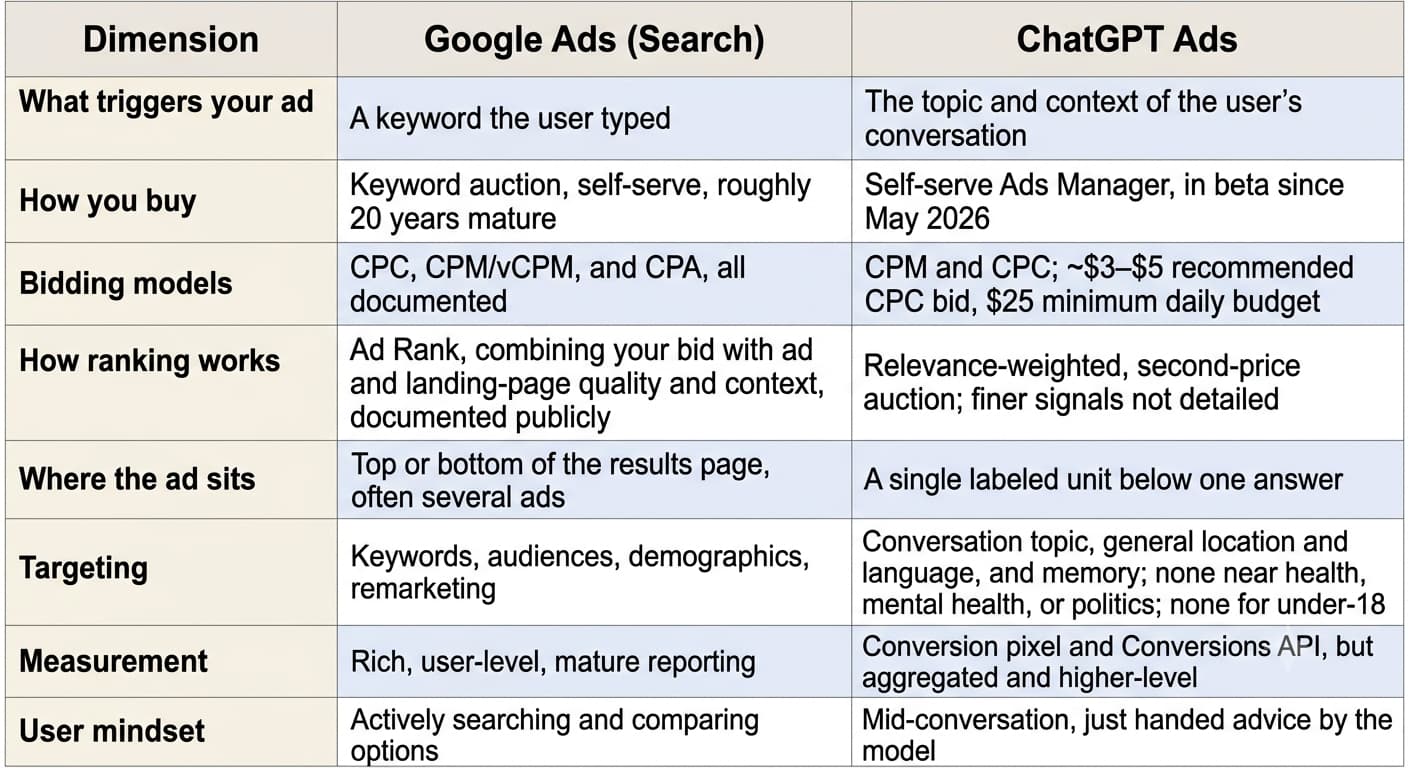
Comparing Google Ads against ChatGPT Ads
Read the table and a pattern jumps out. The two platforms are converging on tools, both offering CPM and CPC bidding, a self-serve manager, and a conversion pixel, while they still differ most on maturity and on the exact moment they catch your customer.
So what actually transfers from your Google Ads experience? More than you’d expect. The bidding logic is identical, CPC when you want measurable clicks and actions, CPM when you want cheap awareness. The discipline of tracking conversions carries straight over, because ChatGPT now hands you a pixel to do it. And the instinct that relevance lowers your cost, the one Quality Score drills into every Google advertiser, still applies, even though OpenAI hasn’t published its own version of that math.
What doesn’t transfer matters just as much. There’s no keyword research, because there are no keywords to bid on, so every hour you’d normally spend in a keyword planner has no equivalent here. There’s no granular audience targeting or retargeting, because you get aggregated results rather than user-level profiles. And the intent is different in kind. A Google searcher who typed “best CRM for small business” is actively shopping. A ChatGPT user who got a CRM recommendation in the middle of a longer conversation about running their company is in a warmer, earlier, less commercially-triggered moment, and that changes what your ad should say to them.
The mistake I’d expect most teams to make is treating ChatGPT ads like a new Google Ads campaign, importing keyword-style thinking into a place that has no keywords. The teams that win early will be the ones who treat this as its own surface, a placement that appears right after the model gave someone advice, and write for that exact moment. It’s early, the economics aren’t public, and the reach is far smaller than search. But the advertisers learning this surface now, while it’s cheap and uncrowded, are the ones who’ll understand it when it’s neither.
What This Means for Advertisers and Brands
The short version is test, don’t overcommit. ChatGPT ads are real, spreading, and now actually buyable through the self-serve Ads Manager, but the platform is still in beta and opening up gradually, so this is a channel to pilot rather than bet the quarter on. What you can do right now is understand the shift and get your creative and measurement thinking straight before you scale spend.
The shift is about the moment of discovery. A search ad catches someone who’s actively comparing options, scanning results, deciding. A ChatGPT ad catches someone mid-conversation, right after the model has effectively handed them advice. Picture a meal-kit brand. In search, they’d bid on “meal kit delivery” and write a headline around that phrase. In ChatGPT, the relevant moment is someone asking for three weeknight dinners the kids will actually eat, and the ad that fits speaks to that exact situation, quick, kid-friendly, ready in twenty minutes. Same brand, completely different creative logic. You’re matching a felt need in a conversation, not echoing a search string.
Two habits will serve you when this opens up. Write creative that makes sense sitting directly under a helpful answer, because vague brand-slogan copy will feel like a jarring downgrade after the model just gave someone specific advice. And respect the labeling wall. Your ad has to look like an ad, clearly sponsored and separate, never like it’s part of ChatGPT’s answer. Creative that tries to mimic the assistant’s voice runs straight against OpenAI’s design and is the fastest way to lose trust with the platform and the person reading it.
This is the same ground-shift we covered in our Google I/O 2026 recap, where AI started answering questions instead of just pointing at links. The discovery layer your customers use is being rebuilt, and paid ads inside AI answers are the next piece of it. If you want help thinking through where your budget actually belongs across all of it, that’s the conversation worth having now.
ChatGPT ads are one of the fastest-moving stories in digital advertising, and it’s already hard to tell OpenAI’s actual rules from the guesswork filling everyone’s feed. Adotme has tracked this rollout since the first announcement, and we help brands turn it into a real plan, from testing the self-serve Ads Manager to building the creative and conversion tracking that make it perform, through our digital advertising services. We pair that with organic SEO built for the AI era, so you’re earning visibility inside AI answers, not only buying it. Want a straight read on whether ChatGPT ads fit your business right now? Reach out and the conversation doesn’t cost anything.
External references: OpenAI — Our approach to advertising and expanding access · OpenAI — Testing ads in ChatGPT · OpenAI — New ways to buy ChatGPT ads · OpenAI Help Center — Ads in ChatGPT: The Basics · OpenAI Help Center — Create Campaigns for ChatGPT · OpenAI Developers — Ads measurement pixel · Google Ads Help — About the ad auction
Frequently Asked Questions (FAQs)
Does ChatGPT have ads now?
Yes. OpenAI announced ads on January 16, 2026 and began testing them in the United States on February 9. Ads appear only for people on the Free and ChatGPT Go plans, shown as a single sponsored unit below a ChatGPT response and clearly labeled as sponsored. The higher paid tiers, meaning Plus, Pro, Business, Enterprise, and Edu, don’t show ads. Since launch, the test has expanded to more countries including Canada, Australia, and New Zealand, with the United Kingdom, Mexico, Brazil, Japan, and South Korea planned.
How much do ChatGPT ads cost for advertisers?
OpenAI supports both CPM (cost per thousand impressions) and CPC (cost-per-click) bidding through its self-serve Ads Manager. For CPC campaigns, OpenAI recommends a starting maximum bid of $3 to $5 per click, and it sets a $25 minimum daily budget per campaign. Ads run through a relevance-weighted, second-price auction. What OpenAI hasn’t published is competitive clearing prices or performance benchmarks like typical CTR or cost-per-acquisition, so your real cost and results only become clear once campaigns run at scale. Treat any blog quoting a fixed “ChatGPT ads cost $X” beyond those official starting figures as an estimate.
Can advertisers see my ChatGPT conversations?
No. OpenAI states that advertisers don’t receive your chats, chat history, memories, name, email, precise location, or IP address. Advertisers get only aggregated, non-identifying information about how their ads performed, such as the number of views or clicks. Even with OpenAI’s newer conversion-tracking pixel and Conversions API, advertisers see only aggregated results, never individual conversations. OpenAI has also said the data is never sold to advertisers, and you can turn off ad personalization and clear the data used for ads under Settings and Ad Controls.
Which ChatGPT plans show ads?
Ads appear only on the Free and ChatGPT Go plans. ChatGPT Go is OpenAI’s cheapest paid tier, launched globally on January 16, 2026 at $8 per month in the U.S. The higher tiers, Plus, Pro, Business, Enterprise, and Edu, are ad-free. Free users can also opt out of ads, but OpenAI trades that for a lower daily message limit, so the ads-free experience means fewer messages per day.
Are there topics where ChatGPT won’t show ads?
Yes. OpenAI has said ads are not eligible to appear near sensitive or regulated topics, and it named personal health, mental health, and politics specifically. Ads also won’t show in accounts where the user has said, or OpenAI predicts, that the person is under 18. For logged-out users, ads are limited to content appropriate for all ages. These exclusions are set by OpenAI and aren’t something an advertiser can pay to get around.
How is advertising on ChatGPT different from Google Ads?
Google Ads runs on a keyword auction with pricing and ranking mechanics Google documents publicly. ChatGPT ads are matched to your conversation rather than a typed keyword, appear as a single labeled unit below one answer, and give advertisers aggregated results rather than user-level data. Both now support CPM and CPC bidding, and ChatGPT has a self-serve Ads Manager that runs a relevance-weighted, second-price auction, but OpenAI hasn’t published competitive clearing prices or performance benchmarks, and its measurement is higher-level than Google’s. The platforms are converging on tools while differing most on maturity and on where they catch the user, Google at the moment of active search, ChatGPT mid-conversation.
Relevant Topics:

Dash Sze
Adotme Copywriting Team
"I write strategic content that drives traffic, converts audiences and scales brands."