Back to posts
Ads in Google AI Overviews: What’s Actually Running in 2026

Dash Sze
10 min read
Sep 21, 2026
Overview
Run Google Search, Shopping, or Performance Max? Then there’s a strong chance you’re already advertising inside Google’s AI Overviews right now. (Performance Max is Google’s fully automated campaign type, the one that spreads a single budget across all of Google’s ad slots for you.)
You didn’t sign up for it. You can’t switch it off. Your reporting won’t even show it to you as its own line.
That isn’t a bug. Google built it that way on purpose.
AI Overviews, the AI-written summary now sitting at the top of a huge share of Google results, never got a separate ad product you opt into. It made your existing campaigns eligible to appear inside that summary, then left the buying, bidding, and auction exactly where they already were.
So the change landed in your account whether you were watching for it or not.
Most coverage of AI Overview ads mixes real announcements with guesses about pricing and targeting Google never published. Every fact here comes straight from Google’s own announcements and its Ads Help documentation.
What Google act
ually announced (and when)
Ads in AI Overviews rolled out in stages over roughly two years. The timeline matters, because it tells you how settled this is. It’s a shipped, documented part of Google Ads.
At Google Marketing Live in May 2024, Google said it would start testing Search and Shopping ads inside AI Overviews, US users first, mobile first. That was the first time ads showed up within the AI-written answer instead of only above or below it.
At Google Marketing Live 2025, Google pushed the program in two directions. It brought ads in AI Overviews to the desktop in the US. And it announced it would start testing ads in AI Mode.
The same event launched AI Max for Search campaigns, the AI-powered engine that now decides which searches your ads match. Later in 2025, ads in AI Overviews reached more English-language markets on both mobile and desktop.
At Google Marketing Live 2026, in May, AI Mode was the headline. Google introduced four new ad formats built with its Gemini AI model, expanded its Direct Offers shopping pilot, and pushed AI Mode ads from an experiment toward a real surface. We covered the wider set of changes in our Google I/O 2026 recap; this is the paid-media half of that story.
Ads in AI Overviews are documented and broadly live. Ads in AI Mode are newer and still a test.
That gap between “live” and “testing” is where most of the confusion online comes from.
Where the ads appear: AI Overviews vs AI Mode
AI Overviews and AI Mode are two different surfaces, and mixing them up leads to bad decisions.
An AI Overview is the AI-generated summary Google drops at the top of a normal results page for many queries. The familiar blue links still sit underneath it.
AI Mode is separate and more conversational, built for complex, follow-up-heavy questions where Google answers in a back-and-forth thread instead of handing you a page of links.
Ads run in both. They just look and behave differently in each.
In AI Overviews, ads show up in two spots. Text and Shopping ads where they appear on the right side of the Overview, woven into the summary. The same ad can also run above or below it, in the classic search positions, as text, Shopping, local, or app ads. Either way it carries a “Sponsored” label, kept visually separate from the AI answer.
In AI Mode, the ad is stitched into the conversation itself. Google calls these ads “integrated directly into AI-generated responses” while staying “clearly labeled as an ad.”
Instead of a static text line, an AI Mode ad adapts its wording to the question and explains why a specific product fits, using verified product details pulled in by Gemini. Picture a salesperson who joins the chat only when the answer calls for a product. That’s the idea, and it’s why Google built new formats just for it.
Why is Google pouring ad space into this surface? Google says 75% of people make more confident decisions, and 77% make faster ones, when they use AI Mode in Search, citing an Ipsos Global Consumer Journeys survey it commissioned in December 2025.
Whether those figures hold up or not, they explain the direction. Google is moving ad inventory to where it believes buying decisions now happen.
The part most advertisers miss: you’re already in it
You do not build a separate campaign to run ads in AI Overviews. Your current campaigns are already eligible.
Google’s Ads Help documentation says plainly: “Text and Shopping ads from existing Search, Shopping and Performance Max campaigns are eligible to show within the AI Overviews.” An ad qualifies when it can win the standard auction and it addresses both the user’s question and the AI Overview’s content.
No new ad type. No new bidding model. No separate budget line. It’s your normal auction, showing up in a new place.
That design comes with two hard limits. You can’t opt out. In Google’s words, “No, you can’t opt out of serving ads in AI Overviews.” And you can’t target it directly, either.
So the lever most advertisers reach for, turning a placement on for the winners and off for the rest, doesn’t exist here. You’re in, and Google decides when you show.
One thing softens the “you’re always in” picture. Google says it doesn’t run AI Overview ads for sensitive categories like adult, alcohol, gambling, finance, healthcare, and politics. Advertise in one of those, and this may not touch your account yet.
There’s a geographic line, too. Ads within AI Overviews currently run in English on mobile and desktop across 12 markets: Australia, Canada, India, Indonesia, Kenya, Malaysia, New Zealand, Nigeria, Pakistan, Philippines, Singapore, and the United States.
Advertise in English in one of those markets? It’s already live in your account. If you don’t, it’s coming, and the expansion pattern says sooner rather than later.
For a lot of advertisers, “should I run ads in AI Overviews?” is the wrong question, because you already are. The real question is whether your campaigns are built to compete well there.
The new Gemini ad formats in AI Mode
AI Mode is where Google is doing its most visible new building. At Google Marketing Live 2026 it introduced four ad formats made with Gemini, each designed to sit inside a conversation rather than on a results page.
Conversational Discovery ads answer a specific question a shopper asks mid-chat. Google’s example is a search about making a home smell like a spa, which surfaces an ad for the relevant product’s features. What makes it distinct is the independent, AI-written explainer paired with your creative, all under a “Sponsored” label.
Highlighted Answers drop a relevant ad inside the recommendation list AI Mode generates. Google’s example is a set of language-app picks for someone planning travel. Your product shows up as one of the AI’s suggestions, not a banner bolted to the side.
AI-powered Shopping ads use Gemini to pull relevant products and write a custom reason each one fits. Google’s example is an espresso-machine search that returns a product display with a personalized rationale. It’s aimed at higher-consideration buys, where a shopper wants a reason, not just a price.
Business Agent for Leads swaps the static lead form for an interactive chat agent, also powered by Gemini. Instead of filling out fields, a prospect gets answers on the spot, drawn from your website. Google’s example is a student getting live answers to university questions right inside the ad.
All four run through Performance Max and AI Max campaigns. And all four are still in testing. Treat them as a preview of where AI Mode advertising is heading, not a channel you can plan a quarter around today.
Google also expanded its Direct Offers pilot alongside them, adding AI-built promotion bundles, native checkout through its Universal Commerce Protocol (Google’s standard for finishing a purchase inside an AI shopping flow), and travel deals through Booking and Expedia.
How the matching actually works
There’s no keyword box to bid on inside an AI answer. So how does Google pick which ad to show?
For AI Overviews, Google says ads are matched using “both the user query as well as the content of the AI Overview.” The match depends on the words someone typed and on what the AI actually wrote in its answer.
That shapes what Google tells you to do. It recommends broad match or keywordless targeting paired with Smart Bidding.
Broad match is the loosest keyword setting, where Google can show your ad for searches related to your terms rather than only your exact wording. Keywordless targeting goes further and drops the keyword list entirely, letting Google’s AI find the searches. Smart Bidding is Google’s automated bidding, setting your bid in real time for each auction.
Google wants its own AI deciding where you fit, not a tight keyword list.
The engine underneath most of this is AI Max for Search campaigns, launched in 2025 and called by Google one of its fastest-growing Search ads products. AI Max matches your ads to searches without leaning on your keyword list, and it uses Final URL expansion, where Google’s AI picks the most relevant landing page on your site for each search.
Handing that much to the machine sounds risky, so Google built a steering wheel. It’s called AI Brief, a Gemini-powered control panel where you set the guardrails: what your ads should and shouldn’t say, which searches to capture or avoid, and who to reach.
For AI Mode specifically, Google has said less, and I won’t pretend otherwise. It’s confirmed the ads run on AI Max and Performance Max and adapt to the conversation. It has not published how a single ad gets chosen inside a multi-turn thread.
The reporting blind spot
You can’t currently see, in your reports, how your ads perform inside AI Overviews.
Google states as much: “Google Ads currently doesn’t offer segmented reporting when ads show within Search AI Overviews.” Those impressions and clicks fold into your standard metrics as “Top Ads.”
The performance is real and it’s counted. It’s just blended into your existing numbers with no way to pull it apart. You can’t isolate an AI Overviews column, compare its cost per conversion to regular search, or judge the placement on its own.
That has a real consequence. When your Search or Performance Max results move, part of that movement may be coming from AI Overview placements you can’t separate out. You’re optimizing partly blind.
Google may add segmented reporting later, since “currently doesn’t offer” leaves the door open. For now, treat any tool or agency promising a clean “AI Overviews performance report” with suspicion. Google isn’t handing that data out yet.
The workaround isn’t a dashboard. It’s discipline.
Keep your conversion tracking airtight. Lean on the value-based and Smart Bidding signals Google does act on. Judge the account on total outcome, meaning cost per booked job, cost per sale, and return on ad spend, not on a placement breakdown Google won’t give you.
Not sure how much of your spend is now flowing into AI surfaces? That’s exactly what a proper account audit surfaces. Our free ad audit reads the account the way Google actually serves it today, not the way the old reports imply.
Ask yourself these questions
- Do you advertise in English in one of the 12 live markets, where ads in AI Overviews are already running in your account?
- Is your conversion tracking solid enough to judge performance on total outcome, given that you can’t isolate AI Overview results?
- Are your campaigns built on broad match or keywordless targeting with Smart Bidding, the setup Google says these placements reward?
AI Overview ads vs classic Google Search ads
Most advertisers already run classic Search ads. So the useful comparison is what changes when the same ad shows inside an AI answer instead of on a results page.
The buying stays the same. The control and the context change.
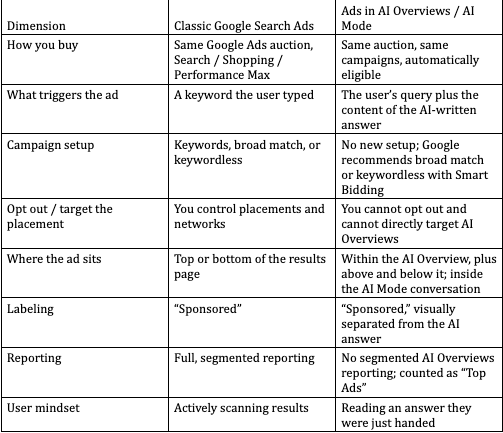
Your bidding, budgets, and campaign types carry straight over, because it’s the same auction. What you lose is granular control and placement-level visibility. What you gain is presence inside the answer a growing share of users read first.
There’s a second comparison worth making, because it’s the other big paid surface in AI search. Google folds AI ads into the system you already use. OpenAI took the opposite route and built a separate platform you log into and buy from directly.
Two roads, one destination. Both lead to paid placement inside AI answers, and most brands will end up needing a plan for both.
What this means for advertisers and brands
You can’t control whether you appear in AI Overviews. So put your energy into what you can control: the strength of your campaigns, the quality of your creative, and the accuracy of your tracking.
Three moves matter most right now.
First, make sure your Search and Performance Max campaigns use broad match or keywordless targeting with Smart Bidding. That’s the setup Google says these placements reward, and a tight exact-match-only account may be quietly leaving AI Overview reach on the table.
Second, tighten conversion tracking until you trust it completely. Total-outcome measurement is the only honest way to judge a channel you can’t segment.
Third, write creative and landing pages that answer a real need, not just a keyword. An ad sitting under an AI answer has to continue the help the user was just given.
Picture a West Loop skincare brand. It sells a $40 vitamin-C serum and runs a lean Performance Max campaign. Six months ago its ad only showed when someone typed close variants of “vitamin C serum.”
Today that same ad can surface inside an AI Overview for a broader question like “how do I fade dark spots without irritation,” sitting right under the paragraph where Google explains the ingredient.
The brand didn’t change a setting. What made the difference was a product page that answered that exact worry, so the ad read as the natural next step instead of an interruption.
Campaign health and page quality now matter more than any hidden lever.
The deeper shift is about where the decision happens. A classic search ad catches someone scanning options and making up their own mind. An AI Overview or AI Mode ad catches someone who was just handed an answer, in a moment that’s warmer and further along.
The advertisers who win early won’t be the ones who found a secret targeting setting. There isn’t one. They’ll be the ones whose campaigns are healthy enough to win the auction and whose creativity earns the click inside the answer.
Paid presence is only half of it. The same AI systems serving these ads also decide which brands get named in the organic answer, and that visibility isn’t something you can buy. Earning it is the work of AI-era SEO, which we cover in why ranking #1 no longer guarantees AI cites you.
Still deciding where paid dollars should go in the first place? Our guide to which advertising platform fits your business is the place to start. The brands that show up in both the ad and the answer are the ones building for this on purpose.
Ads in AI search went from experiment to standing part of Google Ads faster than most teams noticed, and the reporting gap means a lot of advertisers are optimizing a surface they can’t see. Adotme has tracked this rollout since the first AI Overview test, and we help brands turn it into a real plan, auditing where your budget actually flows, building the campaign structure these placements reward, and tightening the conversion tracking that makes total-outcome measurement trustworthy, all through our digital advertising services. We pair that with organic SEO built for the AI era, so you’re earning a place in the answer, not only buying one beside it. Want a straight read on how much of your spend is already running through AI surfaces? Reach out, and the audit doesn’t cost anything.
Frequently Asked Questions (FAQs)
Are there ads in Google AI Overviews right now?
Yes. Google shows Search and Shopping ads both inside AI Overviews and in the usual spots above and below them, each labeled “Sponsored.” The ads come from advertisers’ existing Search, Shopping, and Performance Max campaigns, which are automatically eligible. Ads within AI Overviews currently run in English across 12 markets, including the United States, Canada, Australia, and India, on both mobile and desktop.
Do I need to build a special campaign to advertise in AI Overviews?
No. There’s no separate AI Overviews campaign or ad type. Google makes your existing Search, Shopping, and Performance Max campaigns automatically eligible, as long as they can win the standard auction and match both the query and the AI Overview’s content. You can’t opt out and you can’t directly target it, so the work is making your current campaigns strong rather than building something new.
How much do ads in AI Overviews cost?
There’s no separate price. AI Overview placements run through the same Google Ads auction and the same bids as your normal Search, Shopping, and Performance Max campaigns, so your cost is set by your existing bidding and Smart Bidding strategy, not a special AI Overview rate. Any article quoting a fixed “AI Overview ad cost” is describing something Google hasn’t published.
Can I see how my ads perform inside AI Overviews?
Not separately. Google states it “currently doesn’t offer segmented reporting when ads show within Search AI Overviews.” Impressions and clicks fold into your standard metrics as “Top Ads,” with no column to isolate the placement. Keep conversion tracking accurate and judge performance on total outcomes like cost per lead or return on ad spend.
What’s the difference between ads in AI Overviews and ads in AI Mode?
AI Overviews are the AI summaries at the top of a normal results page, and ads there are documented and broadly live. AI Mode is Google’s separate conversational search experience, and ads there are newer and still in testing. In May 2026, Google introduced four Gemini-built formats for AI Mode, namely Conversational Discovery ads, Highlighted Answers, AI-powered Shopping ads, and a Business Agent for Leads, and they embed the ad directly into the conversation.
How does Google decide which ad to show in an AI Overview?
Google says it matches ads using both the user’s query and the content of the AI Overview itself, not just the typed keywords. It recommends broad match or keywordless targeting with Smart Bidding, and most of the matching runs through AI Max for Search, which pairs ads to searches without a keyword list and picks the most relevant landing page automatically. Google has not published the exact ranking formula, especially for AI Mode, so treat any precise “AI ad algorithm” claim as speculation.
Relevant Topics:

Dash Sze
Adotme Copywriting Team
"I write strategic content that drives traffic, converts audiences and scales brands."